Author: admin

  • Buy Now Pay Later Car Insurance: Is It Right for You?

    Created on February 1, 2026Updated on April 23, 2026

    Car insurance can feel expensive when it lands on top of fuel, maintenance, rent, groceries, and everything else. That is why many drivers look for payment flexibility. But the real question is not only whether you can split the cost. It is whether the payment structure fits your budget without creating bigger problems later. In many cases, Buy Now Pay Later car insurance is best understood as a payment arrangement layered onto a standard auto policy, not a completely separate type of coverage.[1]

    If you are new to the concept, start with what buy now pay later car insurance is. Then compare it with other BNPL car insurance options so you can judge the structure, the fees, and the long-term fit more clearly.

    When it can help

    BNPL can reduce the amount due upfront and make coverage easier to start.

    What to compare

    Total cost, payment rules, coverage quality, and what happens if you miss a payment.

    Main risk

    A low first payment can hide fees, tighter terms, or a higher total cost.

    Best fit

    Drivers who need lower upfront pressure and can reliably manage recurring payments.

    What BNPL Car Insurance Usually Means

    Buy Now Pay Later car insurance usually refers to a payment arrangement where the premium is split into installments rather than paid in one larger amount at the beginning. California’s DFPI explains that premium finance companies may advance money directly or indirectly to an insurer or producer at the insured’s request under a premium finance agreement.[1] In simple terms, the coverage may still look similar to a traditional policy, but the billing setup is structured to spread the cost over time.

    That can be useful when upfront cost is the biggest obstacle. But a lower starting payment should never be confused with guaranteed savings. A plan that feels easier today can still cost more by the end of the term if service fees, installment charges, or payment-related penalties apply.

    When BNPL Can Be a Good Fit

    BNPL-style payments may be a good fit when your main challenge is the size of the first payment. This can matter if you need coverage quickly and do not want one large bill to disrupt your monthly essentials. For some drivers, the ability to spread payments out can make it easier to start or maintain coverage instead of going uninsured because the initial price feels out of reach.

    • You need a lower amount due at the start of coverage.
    • You have steady enough cash flow to handle scheduled payments reliably.
    • You understand the total amount you will pay over the term.
    • You are using flexible payments to manage cash flow, not to ignore the true cost.

    If your main goal is reducing the initial burden without losing sight of value, it may also help to review affordable coverage without a down payment.

    When BNPL Might Not Be Right for You

    BNPL is not always the right answer. It can look cheaper at signup while becoming more expensive later if fees stack up or if the recurring payment schedule is harder to maintain than expected. California’s Department of Insurance notes that insurers may have fee categories tied to billing and policy administration, including installment fees, late fees, cancellation fees, reinstatement fees, premium finance revenues, and installment finance charges.[2]

    Practical takeaway: the best question is not “How low is the first payment?” It is “What is the full amount I will pay by the end of the policy term, and what happens if I fall behind?”

    Fees can add up

    A smaller upfront payment may still lead to a higher total bill.

    Missed payments matter

    Late or missed payments can trigger penalties, cancellation, or reinstatement issues.

    Some plans are stricter

    Not every provider offers the same flexibility, grace periods, or coverage options.

    Budget stress can show up later

    A plan that feels easy on day one may feel different after several recurring payments.

    That is why it is smart to compare terms closely and also review the main BNPL risks before you commit.

    Coverage Still Has To Make Sense

    Payment flexibility is only one part of the decision. You still need the right protection. Washington’s insurance guidance explains that collision covers damage to your car from a crash, while comprehensive covers losses such as theft, vandalism, fire, hail, or other non-collision events.[3] That means a lower starting payment is not a win if the quote leaves you underinsured or strips out protection you actually need.

    What to Compare Why It Matters
    Liability limits You still need limits that fit your legal obligations and real risk.
    Collision and comprehensive These can matter a lot on financed, leased, or newer vehicles.
    Deductibles A lower premium can come with a deductible that is harder to absorb after a loss.
    Optional add-ons Roadside assistance, rental reimbursement, and other extras can change the policy’s value.

    Will BNPL Work With Your Financial Habits?

    This may be the most important question of all. BNPL-style insurance can be useful for drivers who stay organized with due dates and want lower upfront friction. It may be less suitable for someone who already struggles with recurring payments or wants to minimize monthly obligations. The strongest plans are the ones you can keep stable, not just the ones you can start.

    • Cash flow: Do you need a lower upfront amount right now?
    • Consistency: Can you make every payment on time without stress?
    • Total cost: Have you checked the full amount paid across the term?
    • Coverage: Are you still keeping the protections you actually need?
    • Rules: Do you understand late fees, cancellation, and reinstatement terms?

    Financed Vehicles Make the Decision More Serious

    If your vehicle is financed or leased, the stakes are higher. The CFPB explains that if your insurance lapses, the lender can obtain force-placed insurance to cover the vehicle. That coverage protects the lender and vehicle, but not you.[4] So if you are choosing BNPL only because the first payment is smaller, make sure the later payments are still realistic. A lapse can become much more expensive than the initial problem you were trying to solve.

    Category BNPL-Style Payments Traditional Billing
    Upfront cost Often lower Often higher
    Fees to review Installment, service, late, or finance-related charges Possible billing, late, cancellation, or reinstatement fees
    Total cost Can rise if fees add up Can be lower overall if fewer add-on charges apply
    Best fit Drivers who need lower upfront pressure and can manage recurring payments Drivers who can handle a larger first payment and want a simpler structure

    FAQ

    What is Buy Now Pay Later car insurance?

    In most cases, it means paying for a standard auto policy through installments or a premium-finance-style arrangement instead of making one larger upfront payment.

    Are there fees associated with BNPL insurance?

    Yes, there can be. Depending on the arrangement, you may see installment fees, late fees, cancellation charges, reinstatement costs, or other payment-related charges.

    Who benefits most from BNPL insurance?

    Drivers who need a lower upfront cost and can reliably handle scheduled payments often benefit the most, especially when they compare total cost carefully first.

    What is the biggest mistake to avoid?

    The biggest mistake is focusing only on the first payment. You should always compare the total cost, the fee structure, and the coverage you are keeping.

    Final Thoughts

    BNPL car insurance can be a smart option when upfront cost is the biggest obstacle. But it is only the right fit if the fees are transparent, the total price still makes sense, and you are confident you can stay on schedule. A flexible payment model can help with budgeting, but the best choice is still the one that gives you the right protection at a cost you can realistically maintain.

    Compare more than the first payment

    Before choosing any plan, compare the full cost, the payment rules, and the coverage details side by side. Visit BNPLCI to explore flexible options with more clarity.

    References

    1. California Department of Financial Protection and Innovation — Insurance Premium Finance
    2. California Department of Financial Protection and Innovation — Premium Finance Agreements and Licensed Activity
    3. California Department of Insurance — Prior Approval Rate Filing Instructions
    4. Washington Office of the Insurance Commissioner — A Consumer’s Guide to Auto Insurance
    5. Consumer Financial Protection Bureau — What Kind of Auto Insurance Options Are Available When Financing a Car?
  • Buy Now Pay Later Car Insurance Comparison: Providers, Costs & Terms

    Created on February 1, 2026Updated on April 23, 2026

    Choosing between Buy Now Pay Later car insurance and traditional car insurance usually comes down to one main question: how do you want to pay for coverage? In many cases, the underlying policy can still be a standard auto policy. What changes most is the billing structure, the amount due upfront, and the fees or payment rules that apply over time.[1]

    If you are still getting familiar with the concept, start with buy now pay later car insurance options. The smartest comparison is not just about the first payment. It is about the total cost, the coverage you are actually getting, and whether the plan stays manageable for the full term.

    Traditional billing

    Often simpler and more familiar, but sometimes comes with a larger payment at the start.

    BNPL-style billing

    Usually lowers the upfront burden by spreading the premium into smaller payments.

    Main risk

    A lower first payment can hide the real long-term cost if fees or finance charges apply.

    Best comparison method

    Compare total amount paid, coverage details, and payment rules side by side.

    Understanding Traditional Car Insurance Models

    Traditional car insurance typically means you buy a standard policy and pay for it through the insurer’s usual billing methods. That may mean paying in full, making a larger initial payment and then paying monthly, or following another standard installment plan. For some drivers, this structure feels more predictable because the policy and the billing are handled directly through the insurer.

    Traditional policies can still be a strong fit for drivers who want a cleaner billing setup and who can comfortably handle a larger payment at the beginning. If you want a broader comparison page on the same topic, you can also review BNPL vs traditional car insurance.

    Traditional Policy Feature What It Usually Means
    Amount due at the start Often higher than a payment-flexible arrangement.
    Billing style Usually handled under the insurer’s standard rules and schedule.
    Policy term Often a fixed six- or twelve-month term, depending on the insurer.
    Possible fee exposure May still include installment, late, reinstatement, or cancellation fees depending on billing method.

    The Rise of Buy Now Pay Later Car Insurance

    BNPL-style car insurance is best understood as a payment arrangement, not a completely separate category of coverage. California’s DFPI explains that premium finance companies may advance money directly or indirectly to an insurer or producer under a premium finance agreement.[1] In practice, that means you may still be buying a standard auto policy, but the premium is being paid over time through installments or financing-style terms.

    This type of setup can appeal to drivers who need coverage now but do not want a large upfront bill. It can also help people smooth out cash flow from month to month. But payment flexibility should not be confused with guaranteed savings. A lower startup amount can still lead to a higher total cost if service fees, installment charges, or finance-related costs are added later.

    Coverage Matters More Than the Payment Label

    One mistake drivers sometimes make is focusing too heavily on how the premium is paid and not enough on what the policy actually covers. Whether you choose traditional billing or a BNPL-style arrangement, you still need to compare liability limits, deductibles, collision, comprehensive, and any add-ons that matter for your situation.

    • Liability limits: Make sure the policy fits your legal obligations and real financial risk.
    • Collision coverage: Important if you want protection for your vehicle after a crash.
    • Comprehensive coverage: Useful for theft, vandalism, weather events, and other non-collision losses.
    • Deductibles: A lower premium may come with a higher deductible you would have to pay later.

    Washington’s insurance guidance explains that collision covers damage to your vehicle from a collision, while comprehensive covers non-collision events such as fire, theft, vandalism, or hail.[3] Those coverage choices are still central no matter how the premium is billed.

    The Costs Involved

    The most useful way to compare traditional and BNPL-style billing is to look at the total amount paid over the full term. California’s insurance filing instructions show that insurers may have fee categories tied to billing and policy administration, including installment fees, cancellation fees, reinstatement fees, late fees, premium finance revenues, and installment finance charges.[2]

    Practical takeaway: do not compare quotes using the first payment alone. Ask for the total amount you will pay from the first day of coverage to the last installment.

    Comparison Point Traditional Billing BNPL-Style Billing
    Initial payment Often higher Often lower
    Monthly payment structure May be available through the insurer Usually central to the offer
    Fees to review Possible billing or installment fees Possible service fees, finance-related charges, late fees, or reinstatement costs
    Total cost by end of term Can be lower if fewer charges apply Can be higher if payment-related fees add up

    If you want a deeper look at this part of the decision, review BNPL car insurance fees and terms before choosing a provider.

    Potential Drawbacks of BNPL Car Insurance

    BNPL-style billing can help with affordability at the start, but it also comes with trade-offs. It is a smart idea to review BNPL risks before you commit to any plan that stretches payments over time.

    Fees can increase the real cost

    A lower payment today may not mean a lower cost over the full policy term.

    Late payments matter

    Missed payments can lead to fees, cancellation, reinstatement problems, or a lapse in coverage.

    Not every plan is equally flexible

    Some insurers or finance arrangements may limit options or apply stricter terms.

    Budget pressure can show up later

    A plan that feels easy at signup may become harder to maintain after several recurring payments.

    Why Financed Vehicles Raise the Stakes

    If your car is financed or leased, the comparison becomes even more important. Washington’s insurance regulator explains that most lenders require you to carry comprehensive and collision coverage, and if you do not maintain coverage, the lender can buy coverage to protect its interest and charge you for it.[3]

    The CFPB makes a similar point: if your insurance lapses, the lender can acquire force-placed insurance to cover the vehicle. That coverage protects the lender and the vehicle, but not you.[4] This is why a payment plan must be judged not just by how easily it starts, but by whether it is stable enough to keep active.

    Final Considerations

    The right option depends on your budget, the car you drive, and how much payment flexibility matters in your situation. Traditional billing may be the better fit if you can handle a larger amount upfront and want to reduce the chance that extra charges will build up. BNPL-style billing may be the better fit if your main goal is to lower the initial burden and keep the policy manageable within your monthly cash flow.

    What matters most is comparing the whole deal, not just the headline. A smaller first payment is only a good value if the total cost, payment terms, and coverage still make sense over the entire policy term.

    • Check the total cost, not just the startup amount.
    • Review every fee category before you bind the policy.
    • Make sure the coverage still fits your actual risk and legal needs.
    • Pay extra attention if the vehicle is financed or leased.

    FAQ

    What is Buy Now Pay Later car insurance?

    In most cases, it means paying for a standard auto policy through installments or a premium-finance-style arrangement instead of making a larger upfront payment.

    Is BNPL car insurance always cheaper?

    No. It can reduce the amount due at the start, but the total cost may be higher if payment-related fees or finance charges apply.

    Can traditional policies still offer monthly payments?

    Yes. Many traditional insurers offer monthly or installment billing, though the structure and fees can differ from BNPL-style arrangements.

    Why does lapse risk matter more on financed vehicles?

    If coverage lapses on a financed or leased vehicle, the lender may place insurance on the car to protect its own interest, and you may still be charged for it.

    Wrap-Up

    Buy Now Pay Later car insurance can make it easier to get started, but it is not automatically the best deal. Traditional billing may be cleaner or cheaper overall for some drivers, while BNPL-style billing may be more practical for others who need a smaller amount due at the beginning. The smartest choice is the one that gives you the right protection, the clearest terms, and a payment structure you can maintain without creating a bigger problem later.

    Get your comparison started the right way

    Review your options, compare total cost, and keep coverage quality in view before you commit. Visit BNPLCI to explore flexible car insurance payment options.

    References

    1. California Department of Financial Protection and Innovation — Insurance Premium Finance
    2. California Department of Financial Protection and Innovation — Premium Finance Agreements and Licensed Activity
    3. California Department of Insurance — Prior Approval Rate Filing Instructions
    4. Washington Office of the Insurance Commissioner — A Consumer’s Guide to Auto Insurance
    5. Washington Office of the Insurance Commissioner — Learn How Auto Insurance Works
    6. Consumer Financial Protection Bureau — What Kind of Auto Insurance Options Are Available When Financing a Car?
  • Buy Now Pay Later Car Insurance Comparison: Providers, Costs & Terms

    Created on February 1, 2026Updated on April 23, 2026

    Choosing between Buy Now Pay Later car insurance and a traditional auto policy is usually not about two completely different kinds of legal coverage. In most cases, the real difference is how the premium is paid. Traditional billing may require a larger payment at the start, while BNPL-style arrangements usually focus on smaller scheduled payments spread over time.[1]

    If you are still new to the topic, it helps to start with what buy now pay later car insurance is. Once that foundation is clear, the better comparison is not just the first payment. It is the total cost, the fee structure, the coverage you are actually getting, and whether the plan will remain affordable for the full term.

    Traditional billing

    Often simpler, but sometimes requires a higher upfront amount.

    BNPL-style billing

    Usually lowers the amount due today by spreading payments over time.

    Main risk

    A low first payment can distract from fees, total cost, or lapse risk.

    Smartest approach

    Compare total price, terms, and protection together, not separately.

    What Traditional Car Insurance Usually Means

    Traditional auto insurance usually refers to a standard policy billed directly by the insurer under its normal payment rules. That may mean paying in full, paying a deposit and then monthly, or using another standard installment structure. For some drivers, this route is straightforward and may even be the lower-cost option over the full policy term because it can involve fewer add-on charges.

    For a separate side-by-side article on the same topic, you can also review BNPL vs traditional car insurance. The main point is that traditional insurance is still about coverage first, with billing options built around the policy.

    Traditional Policy Feature What It Usually Means
    Upfront payment Can be higher if the insurer requires a larger first payment or deposit.
    Billing structure Usually handled directly through the insurer’s standard schedule.
    Fees May still include installment, reinstatement, or late fees depending on the policy and billing method.
    Total cost May be lower overall if fewer billing-related charges apply.

    What BNPL Car Insurance Usually Means

    BNPL-style car insurance is best understood as a payment arrangement, not a special type of auto coverage. California’s DFPI explains that premium finance companies may advance money directly or indirectly to an insurer or producer at the request of an insured under a premium finance agreement.[1] In practical terms, that means the policy may still be a standard auto policy, but the premium is paid over time through installments or financing-style arrangements.

    If you want to explore that side in more detail, start with BNPL car insurance options. BNPL-style setups can help drivers who need to get insured quickly without a heavy upfront burden, but the better question is always whether the structure still makes sense after every fee and due date is taken into account.

    What Stays the Same Between the Two

    One of the biggest misunderstandings is the idea that flexible payments automatically change the insurance itself. They do not. You still need to compare liability limits, deductibles, physical-damage coverage, exclusions, and optional protections. Washington’s insurance guidance explains that collision covers damage to your vehicle from a crash, while comprehensive covers losses such as theft, vandalism, hail, or fire. Those are coverage choices, not payment choices.[3]

    • Liability limits still matter no matter how the premium is billed.
    • Deductibles can make one quote look cheaper than another even when coverage is not equivalent.
    • Collision and comprehensive can matter a lot on financed, leased, or newer vehicles.
    • Optional add-ons such as roadside assistance or rental reimbursement can change value without changing the payment label.

    If you are comparing flexible payment setups, keep the protections you actually need in view. Payment flexibility is helpful, but it is not a replacement for proper coverage.

    What Usually Changes With BNPL

    The real comparison point is cost over time. A BNPL-style plan may reduce the amount due today, but California’s Department of Insurance notes that auto-insurance-related charges can include policy fees, installment fees, cancellation fees, reinstatement fees, late fees, SR-22 fees, premium finance revenues, and installment finance charges.[2] That is why the first payment alone does not tell you whether one option is truly better.

    Practical takeaway: always ask for the total amount paid across the full term, including every fee category. That single number is often more useful than the first payment shown in an ad or quote screen.

    For a deeper look at those charges, review BNPL car insurance fees and terms. This is where many drivers discover that the most affordable-looking plan at the beginning is not always the cheapest by the end.

    Category Traditional Policy Billing BNPL-Style Payment Setup
    Amount due at the start Often higher Often lower
    Monthly payment structure May be available through insurer billing Usually central to the plan
    Extra costs to watch Possible billing or installment fees Possible service fees, finance charges, late fees, or reinstatement costs
    Total cost by end of term May be lower if fewer charges apply May be higher if payment-related costs add up

    Why Financed Vehicles Make This More Important

    Washington’s insurance regulator explains that most lenders require comprehensive and collision coverage when you lease or finance a vehicle, and if you do not maintain that coverage, the lender can buy coverage to protect its own interest and charge you for it.[3] The CFPB makes a similar point: if your insurance lapses, the lender can obtain force-placed insurance to cover the vehicle, but that coverage protects the lender and vehicle, not you.[4]

    This is why missing payments can matter more than shoppers expect. A plan that looks manageable only on the first day can become expensive very quickly if a lapse triggers lender action or leaves you without the coverage you thought you had.

    Potential Drawbacks of BNPL Car Insurance

    BNPL-style payments can be helpful, but they come with trade-offs that deserve attention upfront. Before committing, it also helps to review the main BNPL risks so you know where the pressure points usually show up.

    Fees can add up

    A lower startup payment can still lead to a higher total policy cost.

    Missed payments matter

    Late payments can trigger fees, cancellation, reinstatement problems, or a lapse.

    Some plans are more restrictive

    Not every provider offers the same coverage options or terms under every payment setup.

    Budget strain can show up later

    A plan that starts easily may feel harder to maintain after several months of recurring bills.

    How To Compare the Two More Intelligently

    Question To Ask Why It Matters
    How much is due today? This tells you whether you can start the policy now.
    What is the total cost over the full term? This reveals whether a “cheaper” start is actually more expensive overall.
    Which fees can apply? Installment, cancellation, late, and reinstatement fees can change the real cost quickly.
    What happens if I miss a payment? This helps you evaluate lapse risk and stability.
    Am I still getting the coverage I need? The best payment plan is not worth much if the protection is too thin.

    Final Considerations

    The right option depends on your budget, the vehicle you are insuring, and how much payment stability matters to you. Traditional billing may work better if you can handle a larger amount upfront and want to reduce the chance of extra charges. BNPL-style billing may work better if you need to lower the starting burden and keep coverage within your monthly cash flow.

    The key is to compare more than the first payment. If you only compare what is due today, you may miss the real financial difference between the two.

    • Check the total cost, not just the first payment.
    • Review every fee category before you bind the policy.
    • Make sure your coverage still fits your legal and financial needs.
    • Pay extra attention if the vehicle is financed or leased.

    FAQ

    Is BNPL car insurance a different type of policy?

    Usually no. In most cases, it is better understood as a payment arrangement applied to a standard auto insurance policy.

    Is BNPL always cheaper?

    Not necessarily. It can reduce the amount due upfront, but fees or finance-related charges can raise the total cost over time.

    Can traditional policies still offer monthly payments?

    Yes. Many traditional insurers offer installment billing, but the structure and total cost can differ from BNPL-style arrangements.

    Why does lapse risk matter so much on financed vehicles?

    If coverage lapses on a financed or leased vehicle, the lender may obtain force-placed coverage that protects its own interest rather than you.

    Wrap-Up

    BNPL-style car insurance can make it easier to get started, but it is not automatically the better deal. Traditional billing can be more stable or cheaper overall for some drivers, while BNPL-style billing can be more practical for others who need a smaller amount due at the beginning. The smartest move is to compare both options based on total cost, payment rules, and coverage quality, not just what looks easiest on day one.

    Get your comparison started the right way

    Review your payment options, check the total cost, and compare real coverage before you commit. Visit BNPLCI to explore flexible car insurance options.

    References

    1. California Department of Financial Protection and Innovation — Insurance Premium Finance
    2. California Department of Financial Protection and Innovation — Premium Finance Agreements and Licensed Activity
    3. California Department of Insurance — Prior Approval Rate Filing Instructions
    4. Washington Office of the Insurance Commissioner — A Consumer’s Guide to Auto Insurance
    5. Washington Office of the Insurance Commissioner — Learn How Auto Insurance Works
    6. Consumer Financial Protection Bureau — What Kind of Auto Insurance Options Are Available When Financing a Car?
  • How to Qualify for bnplci

    Created on April 20, 2026Updated on April 23, 2026

    Qualifying for BNPLCI is not about one universal approval rule. It depends on the insurer or financing arrangement behind the policy, your driving profile, the vehicle you want to insure, your state’s insurance requirements, and how the premium is billed. In other words, flexible payment options can make coverage easier to start, but they do not erase underwriting rules or state minimum coverage laws.

    If you are still learning the basics, start with what buy now pay later car insurance is. Once you understand that BNPL-style coverage is mainly about how the premium is paid, it becomes easier to see what really affects eligibility and pricing.

    What helps most

    A manageable risk profile, accurate information, and a payment structure you can actually keep up with.

    What carriers look at

    Driving history, vehicle type, location, coverage choice, and sometimes credit-related factors where allowed.

    What to avoid

    Choosing a plan based only on the first payment and ignoring the total cost or payment rules.

    Best mindset

    Think in terms of approval plus long-term affordability, not approval alone.

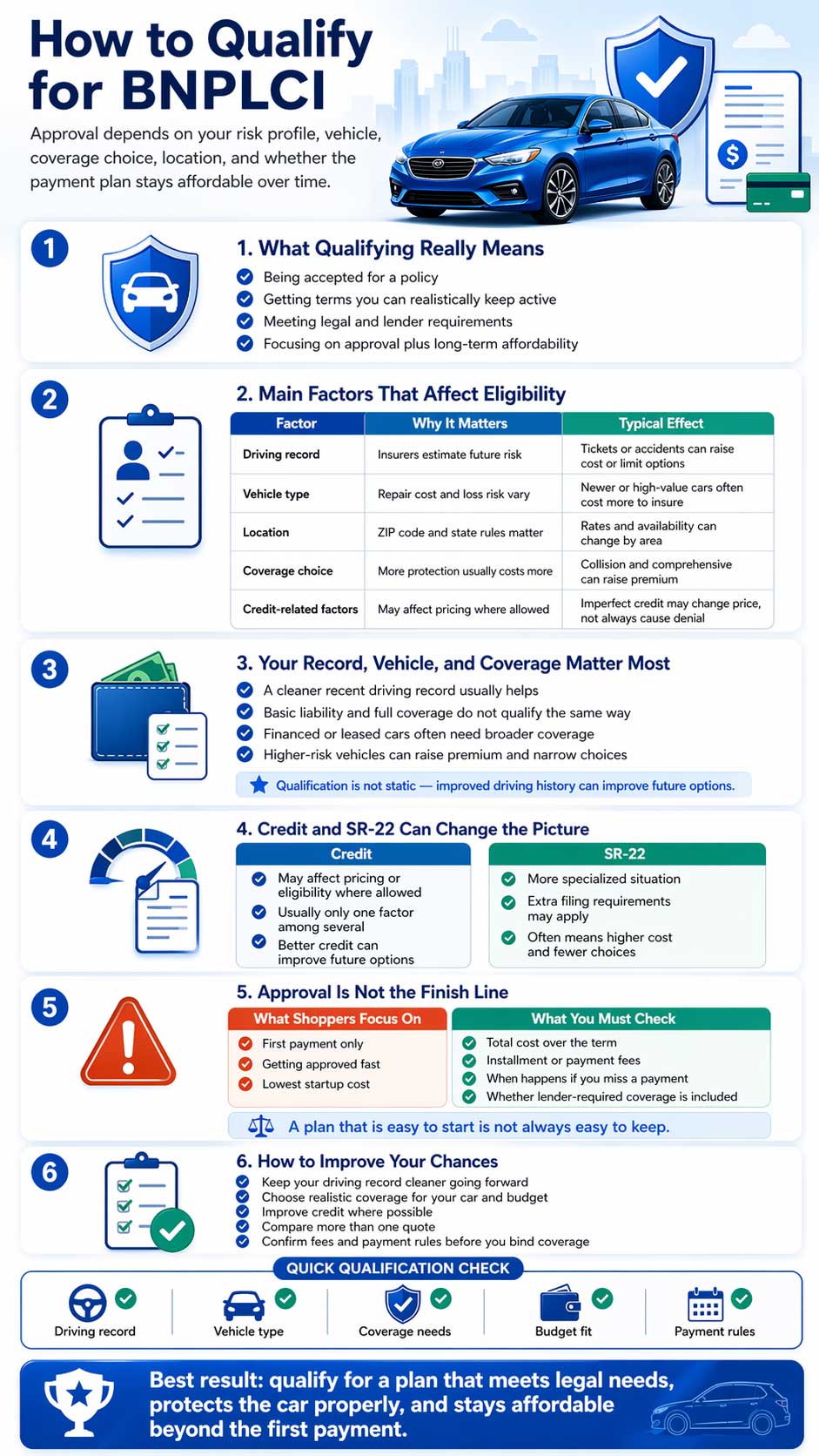
    Infographic explaining how to qualify for BNPLCI, including eligibility factors such as driving record, vehicle type, coverage choice, credit, SR-22 requirements, affordability, and payment rules.

    What “Qualifying” Really Means

    For many drivers, “qualifying” means one of two things: first, being accepted for a policy at all, and second, being offered terms that are realistic enough to keep active. That distinction matters. A quote is not automatically a good fit just because it starts with a smaller upfront payment. The better goal is to qualify for a plan that meets your legal requirements, fits your car, and stays affordable month after month.

    Because BNPL-style arrangements often involve installment billing or premium finance, you should think of them as a payment structure layered onto a standard auto policy, not as a completely separate class of insurance. For a broader payment comparison, see flexible payment plans at BNPLCI and buy now pay later car insurance options.

    Main Factors That Affect Eligibility

    Factor Why It Matters How It Can Affect You
    Driving record Insurers use driving history to estimate future risk. Tickets, accidents, and violations can raise premiums or narrow your options.
    Vehicle type Different vehicles create different repair costs and loss risks. High-value, newer, or more expensive-to-repair vehicles can cost more to insure.
    Where you live Location affects claims patterns, theft exposure, and state requirements. Rates and plan availability can vary by ZIP code and state.
    Coverage selection Minimum liability and broader physical-damage protection are priced differently. Choosing collision and comprehensive usually raises cost but may be required on financed cars.
    Credit-related factors where allowed Some insurers use credit information in underwriting or rating, subject to state law. Credit history may affect eligibility or pricing, but it is not the only factor.

    Maine’s insurance guidance explains that, where credit information is used, insurers may use it for underwriting or rating, but a premium is not based on credit history alone. Other factors can include your driving record, the type of car you drive, and where you live.[1] That makes BNPLCI qualification less about a single “yes or no” and more about how multiple risk factors work together.

    Why Driving Record Still Carries So Much Weight

    A clean driving record does not guarantee the cheapest plan, but it generally improves your position. Insurers use prior accidents, violations, and overall claims exposure to judge risk. Drivers with recent infractions may still find installment-friendly options, but the monthly cost can be higher and the terms can be tighter.

    Practical takeaway: if your record has improved, shop again. Qualification is not static. A better recent record can open up better pricing and more flexible billing options than you had before.

    If you are comparing your next move, it can help to review how BNPL car insurance providers compare instead of assuming all companies treat risk the same way.

    Vehicle and Coverage Choices Can Change the Outcome

    Qualification is also affected by what you are trying to insure. A lower-value car with basic liability-only coverage is a different risk from a newer financed vehicle that needs liability, collision, and comprehensive. Washington’s insurance guidance explains that collision pays for damage to your car after a crash, while comprehensive covers losses such as theft, vandalism, hail, fire, or animal impact. Those coverages often matter more when the vehicle is newer or financed.

    Coverage Choice What It Usually Means Qualification Impact
    State-minimum liability The lowest legal starting point in many states Usually lowers premium, but may leave major gaps in protection
    Liability + collision Adds protection for crash damage to your car Raises cost, especially for higher-value vehicles
    Liability + comprehensive Adds protection for theft, weather, and other non-collision losses Can improve protection but increase premium
    Full physical-damage package Often means liability, collision, and comprehensive together More expensive, but often necessary for financed or leased vehicles

    If you want to compare affordability with payment flexibility, read no down payment car insurance explained and affordable coverage without a down payment.

    Credit History Can Matter, but It Is Not Everything

    One of the weakest parts of the original article was treating credit like a simple pass-or-fail gate. That is not how the issue should be explained. Maine’s consumer guide says that if credit information is used, you should ask whether it affects eligibility, pricing, or both. It also notes that credit history is only one of several factors insurers may use.[1]

    • Late payments and negative public records can hurt your insurance-related credit profile.
    • A longer credit history can help in some scoring models.
    • Improving your credit over time can improve future insurance options.
    • Your premium is still influenced by non-credit factors like driving record, car type, and location.

    That means drivers with limited or imperfect credit may still qualify, but the price and payment structure may change. The honest way to present BNPLCI is not “everyone gets the same flexible deal,” but rather “many drivers can still find options, though terms vary.”

    SR-22 Can Change the Conversation

    If you need an SR-22 filing, your situation is more specialized. California DMV explains that after certain DUI-related actions, a driver may be required to file a California Insurance Proof Certificate, listed as SR-22 or SR-1P, along with other reinstatement steps.[3] In practical terms, that means extra paperwork, a higher-risk profile, and often a more expensive policy.

    Drivers who need SR-22 coverage can still shop for workable payment structures, but they should expect the filing requirement itself to narrow some options and raise cost. This is where comparing carriers carefully matters the most, because not every insurer handles higher-risk drivers the same way.

    Why Payment Structure Matters After Approval

    Qualifying is only the first step. The second step is qualifying for a plan you can actually keep. California DFPI explains that premium finance companies exist to advance money directly or indirectly to an insurer or producer under a premium finance agreement.[2] That is important because it confirms what BNPL-style insurance really is: often a financing or installment mechanism behind an otherwise standard policy.

    A smaller amount due at the beginning can help a driver get insured sooner, but it can also mean more due dates, more chances for fees, and more pressure if your budget is already tight. That is why approval alone should never be the end of the comparison.

    Question Why You Should Ask It
    How much is due today? The startup amount affects whether you can begin coverage now.
    What is the total cost over the term? This tells you whether the plan is actually affordable.
    Are there installment or payment-related fees? Small recurring fees can make a flexible plan cost more than expected.
    What happens if I miss a payment? This reveals lapse risk, reinstatement issues, and possible extra charges.
    Does my lender require broader coverage? Financed and leased vehicles often require more than minimum liability.

    Financed Cars Raise the Stakes

    The CFPB warns that if you do not have insurance when buying a vehicle, or if your coverage later lapses, the lender can obtain force-placed insurance. That coverage protects the lender and the vehicle, but not you.[4] This is one of the strongest reasons to qualify for a plan you can maintain, not just one you can start.

    If your budget is already tight, the risk of a lapse matters even more than the first payment. A policy that feels manageable on day one but becomes unstable after two or three months can create a more expensive problem later. For more on that side of the decision, see understanding BNPL risks.

    How To Improve Your Chances

    Keep your record cleaner going forward

    Old issues cannot always be erased, but avoiding new tickets and claims helps future quotes.

    Choose realistic coverage

    Do not overbuy extras you do not need, but do not underinsure a financed or higher-value car either.

    Improve credit where possible

    Paying bills on time and reducing unresolved credit problems can help over time where credit is used.

    Compare before committing

    Different carriers weigh risk differently, so more than one quote matters.

    • Gather accurate vehicle, driver, and address information before quoting.
    • Ask whether the plan involves installment billing or premium finance.
    • Confirm every fee category before you bind coverage.
    • Review whether the plan still works if your budget gets tighter next month.
    • Shop more than one quote instead of treating the first approval as the best option.

    FAQ

    Does BNPLCI guarantee approval for every driver?

    No. Approval depends on the insurer or payment arrangement behind the quote, your risk profile, your state, the vehicle, and the coverage selected.

    Is bad credit an automatic denial?

    Not necessarily. Where credit is used, it may affect pricing or eligibility, but it is usually only one factor among several. Driving history, location, and vehicle type also matter.

    Can I still qualify if I need SR-22?

    You may still find options, but SR-22 situations are more specialized and often more expensive. Filing requirements and insurer appetite can narrow the choices.

    What is the biggest mistake people make?

    Many shoppers focus only on getting approved or on the first payment. The smarter move is to compare the full cost, the coverage, and how stable the plan will be over the full term.

    Conclusion

    Qualifying for BNPLCI is really about matching three things at once: your risk profile, the insurer’s underwriting rules, and a payment structure you can actually keep active. A clean record helps. A sensible coverage choice helps. Better credit can help where it is used. But the real win is not simply getting approved. It is getting approved for a plan that meets your legal needs, protects the vehicle properly, and fits your budget beyond the first payment.

    Start with the right comparison

    Before choosing a quote, compare how approval factors, coverage needs, and payment terms work together. Visit BNPLCI and review your options with the full cost in mind.

    References

    1. Maine Bureau of Insurance — How Insurers Use Credit Information to Calculate Your Insurance Score for Personal Auto and Homeowners Insurance
    2. Maine Bureau of Insurance — Credit Information Guidance for Underwriting and Rating
    3. California Department of Financial Protection and Innovation — Insurance Premium Finance
    4. California DMV — DUI Convictions and SR-22 Filing Requirements
    5. Consumer Financial Protection Bureau — Auto Insurance Options When Financing a Car
  • Bnplc vs Traditional Car Insurance

    When people compare BNPL car insurance with traditional car insurance, they are usually comparing how the premium is paid, not two completely different legal categories of coverage. In most cases, BNPL-style auto insurance is best understood as a flexible payment approach built around smaller installments, while traditional car insurance usually refers to the standard billing structure offered by insurers. The policy itself can still include liability, collision, comprehensive, uninsured motorist protection, deductibles, and optional add-ons either way.

    If you are new to the concept, it helps to first read what buy now pay later car insurance means. From there, the real question becomes simple: is it better to lower the amount due today, or to focus on the lowest total cost over the full policy term? That is where BNPL-style plans and traditional billing can start to feel very different.

    BNPL-style setup

    Usually aims to reduce upfront pressure by spreading costs into smaller payments over time.

    Traditional billing

    Usually follows the insurer’s standard payment structure, which may still allow installments but often puts less emphasis on payment flexibility.

    What matters most

    Look at the first payment, total cost, fees, due dates, cancellation rules, and whether the policy remains affordable all term long.

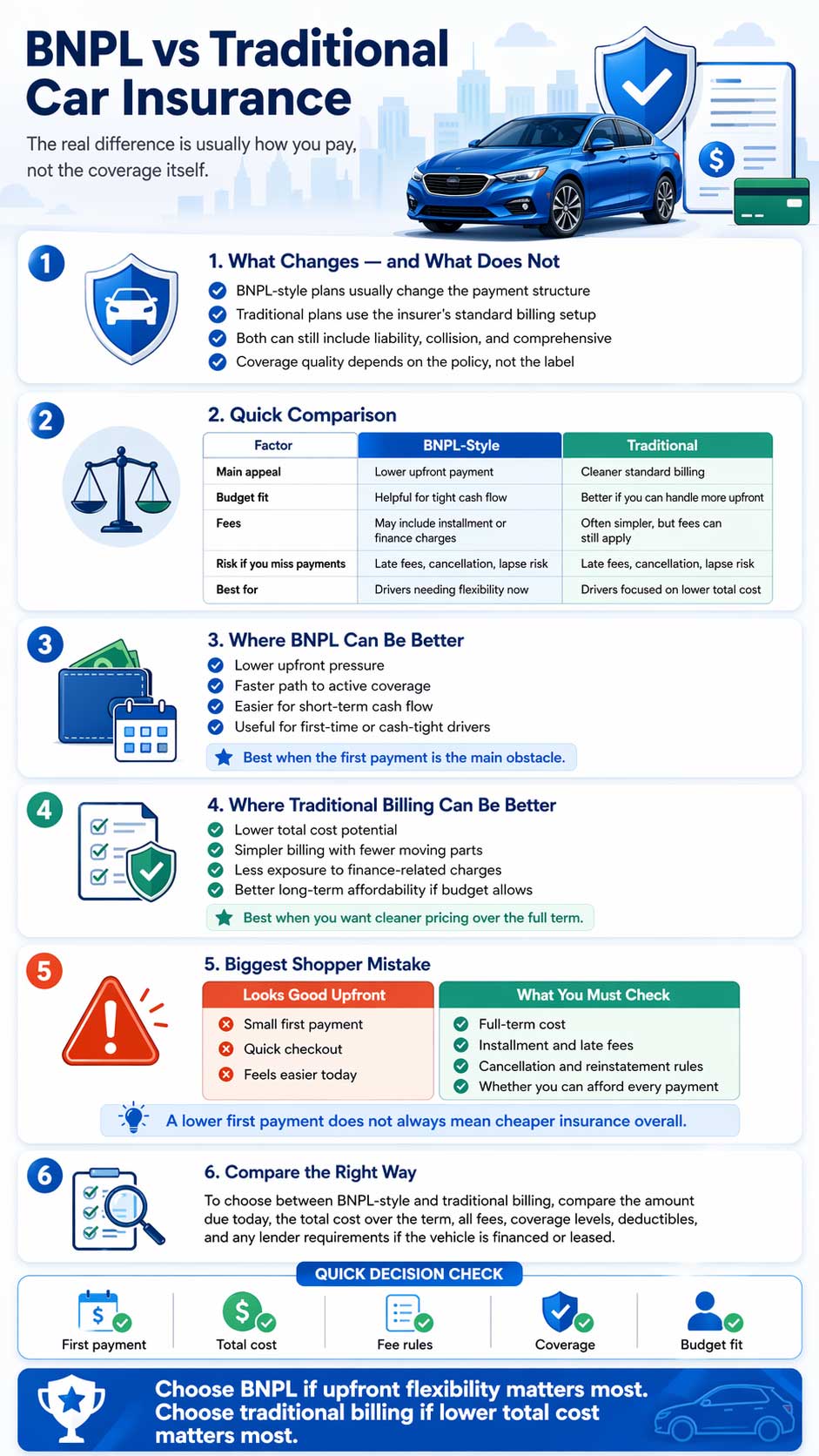
    Infographic comparing BNPL vs traditional car insurance, including payment structure, total cost, fees, coverage, budgeting, and when each option may be the better choice.

    Quick Comparison Table

    Factor BNPL-Style Car Insurance Traditional Car Insurance
    Main appeal Lower upfront payment Cleaner standard billing structure
    Monthly budgeting Often easier for tight cash flow Can still be manageable, but may require more upfront
    Fees May include installment or finance-related charges [1][2] May still include fees, but the structure is often simpler [2]
    Coverage quality Depends on the policy selected, not the payment label Depends on the policy selected, not just the billing method
    Risk if you miss payments Can trigger fees, cancellation, or gaps in coverage [3][4] The same risk exists if a standard policy is not paid on time [3][4]

    What BNPL Car Insurance Really Means

    One of the biggest misunderstandings online is the idea that BNPL car insurance is some entirely separate form of insurance. In reality, the better way to look at it is as a payment structure. California’s DFPI explains that premium finance companies exist to advance money directly or indirectly to an insurer or producer at the request of the insured under a premium finance agreement [1]. That means the customer gets the policy in place, while the cost is handled over time through installments or financing arrangements.

    So when a driver chooses BNPL-style coverage, they are often choosing payment flexibility more than a different protection package. This can be helpful for people who need immediate proof of insurance, want to preserve cash flow, or simply cannot absorb a larger upfront bill. But payment flexibility should never be confused with lower total cost. Smaller payments can feel easier, while still costing more by the end of the term once fees and finance charges are counted [2].

    How Traditional Car Insurance Usually Works

    Traditional car insurance usually means the standard policy and billing options offered directly by insurers. That does not automatically mean “pay in full only.” Some traditional insurers still allow monthly or other installment arrangements. The key difference is that the product is presented primarily as an insurance policy first, while BNPL-style offers are often presented first as a budgeting solution.

    This is why the smartest comparison is not “modern versus old.” It is cash-flow flexibility versus total-cost discipline. Traditional billing can be the better option for drivers who want fewer moving parts, clearer due dates, and less exposure to finance-related charges. BNPL-style billing can be the better option for drivers who need coverage now and need the first payment to stay manageable.

    Where BNPL Can Be Better

    • Lower upfront pressure: Helpful when paying a large amount at the beginning would strain your monthly budget.
    • Faster path to active coverage: Useful for drivers who need to get insured right away for legal driving or registration reasons.
    • Easier budgeting: Smaller scheduled payments may feel more realistic for households managing multiple bills at once.
    • More flexibility for first-time or cash-tight drivers: The lower entry cost may make it easier to stay insured at the start.

    That is why many drivers exploring flexible plans also end up reading about whether buy now pay later is right for them. If the main problem is upfront affordability, BNPL-style billing may solve a real short-term issue better than a traditional setup.

    Where Traditional Billing Can Be Better

    • Lower total cost potential: Fewer installment or finance-related charges can make the full term cheaper [2].
    • Simpler billing: There may be fewer extra fees, fewer third-party arrangements, and less chance of confusion.
    • Stronger long-term affordability: If you can comfortably handle a larger first payment, you may reduce future payment stress.
    • Less risk of payment stacking: Drivers sometimes underestimate how multiple future installments can crowd the monthly budget.

    Traditional billing often works best for drivers who are focused on the entire premium, not just the first amount due. A quote that looks a little harder today can still be the smarter choice if it reduces charges over the next six or twelve months.

    The Biggest Risk: Focusing Only on the First Payment

    A low amount due today can be attractive, but it is not the same as truly affordable insurance. California’s insurance guidance notes that auto insurers may charge a range of fees, including installment fees, cancellation fees, reinstatement fees, late fees, and premium finance revenues or installment finance charges [2]. Those details matter because they change the real cost of the policy even when the initial payment looks small.

    That is also why shoppers should not ignore the downside of missed payments. Maine’s Bureau of Insurance explains that premiums may be higher if prior coverage lapsed while the driver was required by law to carry insurance [4]. Washington’s insurance regulator also warns that if you do not maintain required coverage on a financed or leased vehicle, the lender can buy coverage to protect its own interest and charge you for it [3].

    If you want to go deeper on that side of the topic, this page pairs well with understanding BNPL risks. A flexible payment plan only helps if it is flexible enough for your real budget month after month.

    BNPL vs. Traditional Car Insurance for Financed Vehicles

    If your car is leased or financed, the comparison becomes even more important. Washington’s Office of the Insurance Commissioner states that most lenders require comprehensive and collision coverage on financed or leased vehicles [3]. That means the cheapest-looking payment option may not be enough if it only seems affordable because the driver is underestimating how much full coverage will actually cost over time.

    In these situations, drivers should compare the full monthly commitment, not just the startup amount. A lapse can create bigger problems than just losing your policy. It can lead to lender-placed protection, added expense, or a worse insurance situation later. So the best option is usually the one that keeps the policy active reliably while still meeting lender requirements.

    How to Compare the Two the Right Way

    What to Compare Why It Matters
    Amount due today Shows whether you can realistically start the policy now
    Total amount paid over the term Reveals whether smaller payments actually cost more overall
    Installment, late, cancellation, and reinstatement fees These can turn a “cheap” plan into an expensive one [2]
    Coverage levels and deductibles The payment method does not replace the need for proper protection
    Lender requirements Financed vehicles often require more than minimum liability [3]

    Once you compare plans that way, the choice usually becomes clearer. If you still need help narrowing it down, the next best step is to compare BNPL car insurance providers side by side instead of judging by marketing language alone.

    FAQ

    Is BNPL car insurance a different kind of auto policy?

    Usually not. It is more accurate to treat it as a payment-focused arrangement rather than a separate legal category of coverage. The underlying policy can still include standard auto insurance protections [1][3].

    Is BNPL always cheaper?

    No. It may reduce the amount due upfront, but the total cost can be higher once installment fees, finance-related charges, or late fees are added [2].

    Can traditional car insurance still offer monthly payments?

    Yes. Traditional billing does not always mean paying the full premium at once. Some insurers still offer installments, but the structure and cost details vary by company.

    What is the biggest mistake shoppers make?

    Many drivers compare only the first payment and ignore total cost, lapse risk, lender requirements, and extra fees. That can make a plan look affordable at the start even when it becomes harder to maintain later [2][3][4].

    Final Takeaway

    BNPL vs. traditional car insurance is really a decision about payment flexibility versus overall cost control. BNPL-style plans can be a smart choice when the priority is getting insured now without a heavy upfront hit. Traditional billing can be a smarter choice when the priority is reducing charges and keeping the total price cleaner over the full term. The best option is the one that gives you the right coverage, fits your real monthly budget, and helps you avoid a lapse that could cost even more later.

    References

    1. California Department of Financial Protection and Innovation — Insurance Premium Finance
    2. California Department of Insurance — Prior Approval Rate Filing Instructions
    3. Washington Office of the Insurance Commissioner — Learn How Auto Insurance Works
    4. Maine Bureau of Insurance — A Consumer’s Guide to Personal Auto Insurance
  • BNPL Car Insurance Advantages: Immediate Coverage

    Created on October 15, 2025 | Updated on April 22, 2026
    Important consumer note

    Many drivers use the term BNPL car insurance when they are really looking for a policy with a lower first payment, monthly billing, or a more flexible way to start coverage. In practice, most insurers still require an initial payment before a policy becomes active.[1]

    That means the real benefit is usually not a literal zero-dollar start. It is the ability to begin coverage with a more manageable payment structure while still keeping the policy in force and the vehicle legally insured.[1][2]

    As more drivers search for flexible ways to manage insurance costs, BNPL-style car insurance content has become more popular. The appeal is easy to understand. Car insurance is not optional for most drivers, and the need for immediate coverage often comes at the same time as other expenses such as registration, taxes, fuel, maintenance, and possibly a loan payment. In most states, drivers must carry insurance or otherwise demonstrate financial responsibility to drive legally, and those rules vary by state.[2][3]

    This is why payment flexibility matters. A policy with a smaller first installment can help someone activate coverage sooner without having to pay the entire cost upfront. For first-time drivers, students, households working within a tight monthly budget, and people replacing a vehicle quickly, that can make a meaningful difference. For a deeper introduction to the topic, you can read what BNPL car insurance means.

    Why flexible payment car insurance appeals to drivers

    Lower upfront pressure

    A smaller starting payment can make it easier to begin coverage without wiping out cash needed for other urgent vehicle costs.

    Faster activation

    Many drivers need insurance quickly to register a car, drive legally, or avoid a lapse that can create extra cost later.

    Budget predictability

    Installment-based billing can make the policy easier to fit into a monthly budget, even if the total cost is not lower.

    Key benefits of BNPL-style car insurance

    • It can reduce the amount due at the start of the policy, which may help drivers secure coverage sooner.[1]
    • It can make insurance costs easier to plan around when the premium is spread across monthly installments.
    • It can help drivers avoid delays when they need proof of insurance for legal or practical reasons.[2]
    • It may give shoppers more room to compare deductibles, limits, and discounts instead of focusing only on one large upfront bill.
    • It can be especially useful for people managing other vehicle-related expenses at the same time.

    Flexible billing does not automatically mean cheaper insurance overall, but it can improve short-term affordability. That is one reason many shoppers explore installment-based policies before choosing whether to pay in full. You can also read more about this angle in the benefits of buy now pay later flexibility.

    What immediate coverage really depends on

    Immediate coverage usually depends on the insurer receiving the required payment, approving the application, and issuing the policy. In other words, faster activation is possible, but it is still tied to the insurer’s rules and the completion of the payment process. This is why drivers should always verify when the policy becomes effective instead of assuming that an online quote automatically means they are already insured.[1]

    Factor What it can help with What to verify
    Lower first payment Improves short-term affordability Whether the reduced opening cost increases the total policy price later
    Monthly installments Creates more predictable cash flow Any installment fees, service fees, or late-payment penalties
    Fast online application Can speed up the buying process The exact effective date and time of coverage
    Low advertised rate Attracts shoppers comparing options Coverage limits, deductible, exclusions, and total premium

    Coverage still matters more than the headline offer

    The biggest mistake shoppers make is focusing only on the first payment. A policy can look attractive at the start but still turn out to be a poor fit if the liability limits are too low, the deductible is too high, or the monthly charges are difficult to maintain. State minimum insurance requirements vary, and minimum limits may not be enough to fully protect you after a serious accident.[2][3]

    Drivers with financed or leased vehicles also need to be careful. Collision and comprehensive coverage are not usually required by state law, but lenders often require them for financed or leased cars.[4] That means the cheapest-looking quote may not meet all of your obligations if the vehicle still has a loan or lease attached. For readers exploring low upfront options more broadly, this guide to affordable coverage without a down payment can help connect the budgeting side with the coverage side.

    Shopping question Why it matters Better approach
    How low is the first payment? A low opening payment may not mean a low total cost Compare the full premium for the policy term
    Does it meet state minimum rules? Legal minimums vary by state and may still be limited protection Review both state rules and your personal risk level
    Is the car financed or leased? Lenders may require additional physical damage coverage Confirm lender requirements before choosing the cheapest option
    Are there extra fees? Fees can change the real cost of installment billing Ask about installment, late, cancellation, and reinstatement fees

    Who may benefit most from this type of payment setup

    First-time drivers

    New drivers often need legal coverage quickly and may not have room in the budget for a large upfront payment.

    Budget-conscious households

    Families balancing several monthly bills may prefer a smaller first installment and predictable payment schedule.

    Drivers replacing a car quickly

    When someone needs to get back on the road fast, immediate-start policies with clear payment terms can be especially useful.

    FAQ

    Does BNPL car insurance mean zero payment at the start?
    No. In most cases it refers to a lower upfront payment or installment billing rather than coverage that starts with no payment at all.[1]
    Can this help me get covered faster?
    It can, as long as the insurer completes the application and activates the policy. Drivers should always confirm the exact effective time of coverage before driving.
    Is the cheapest first payment always the best deal?
    Not necessarily. A lower first payment may come with higher monthly costs, fees, or weaker protection. The best comparison is the full premium, coverage limits, deductible, and billing terms.
    Why do financed drivers need to look more closely?
    If the vehicle is financed or leased, the lender may require collision and comprehensive coverage even when state law does not.[4]

    Conclusion

    BNPL-style car insurance can make immediate coverage more accessible by reducing the amount due at the start and spreading the cost across a more manageable payment schedule. That can be a real advantage for drivers who need coverage quickly and are trying to keep short-term cash flow under control.

    The smartest way to use this kind of option is to look beyond the headline. Check the total premium, the effective date, the billing terms, the deductible, and the coverage limits before you commit. For more educational content on flexible payment options and practical car insurance shopping, visit BNPLCI.

    This article is for general informational purposes only and does not constitute insurance, legal, or financial advice. Coverage availability, payment options, premiums, and underwriting rules vary by insurer, state, and driver profile.

  • Understanding Buy Now Pay Later Risks

    Created on February 1, 2026 • Updated on April 22, 2026

    Buy Now, Pay Later can be useful when it helps you avoid a large upfront bill, but its biggest risks usually show up after checkout. The problem is rarely one giant mistake. It is more often a series of smaller obligations, due dates, and fees that start to pile up until your budget feels tighter than expected. That is why payment structure matters just as much as the headline price.[1][2]

    If you are using BNPL for insurance-related costs, the first step is understanding how flexible billing compares with more traditional payment setups. A useful starting point is BNPL vs. traditional car insurance, because the safest choice is not always the one with the smallest first payment.

    Late Fees Add Up Fast

    A missed installment can turn a convenient plan into an expensive one, especially when multiple due dates overlap.

    Small Payments Hide Bigger Totals

    BNPL can feel harmless because each payment looks manageable on its own, even when the combined monthly total is not.

    Terms Matter More Than Marketing

    “No interest” does not mean no risk. The real cost is often buried in late-payment, failed-payment, and cancellation rules.

    Quick takeaway: BNPL is most useful when it solves a short-term cash-flow problem without creating a longer-term payment problem.
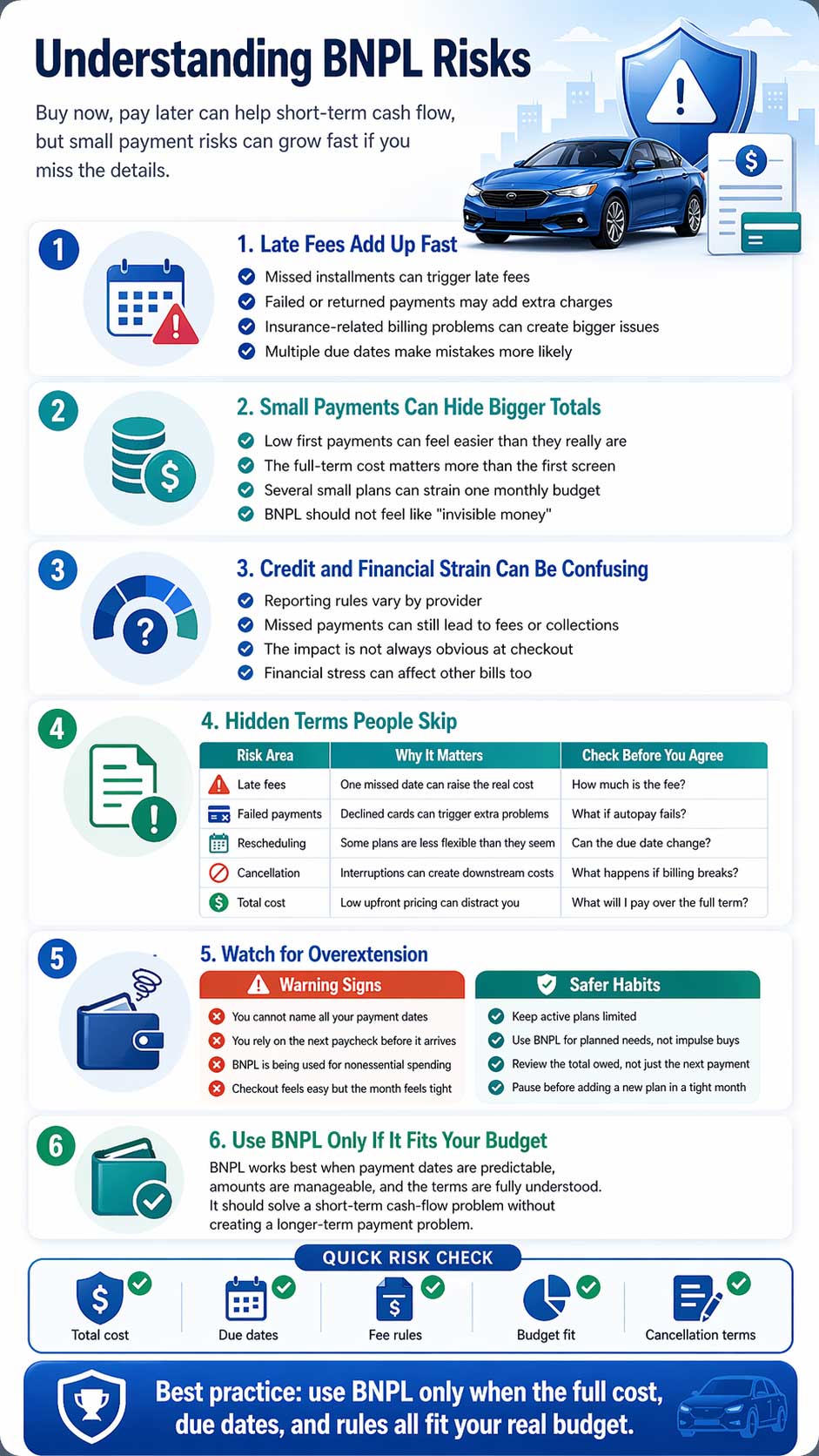
    Infographic explaining BNPL risks, including late fees, hidden terms, total cost, overextension, due dates, and safer budgeting habits for buy now pay later car insurance.

    What BNPL Actually Is and Why It Can Get Risky

    Most BNPL plans split a purchase into several payments. That sounds simple, but the risk rises when you have multiple plans active at the same time or when the due dates do not line up well with your paycheck. CFPB reporting has repeatedly highlighted that consumers can run into trouble when repayment obligations feel manageable separately but become harder to track together.[1][2]

    BNPL can still be helpful. It may prevent a lapse in coverage, reduce pressure from a large upfront payment, or give you more room in a tight month. But those benefits only hold up if the installments remain realistic after your other bills are paid.

    Risk 1: Late Payments That Trigger Fees

    The most common BNPL problem is missing a payment. That often happens not because a person forgot the product existed, but because they are juggling several bills with different due dates. Once a payment is missed, late fees, returned-payment charges, or policy problems can follow quickly.

    If you want to reduce this risk, keep BNPL car insurance fees: what to expect open before you enroll, and compare it with hidden fees in BNPL car insurance so you know what to watch for in the fine print.

    Risk 2: Overspending Because It Does Not Feel Like Debt

    One reason BNPL can be risky is psychological. A smaller first payment makes a purchase feel lighter, even when the full obligation is still substantial. That can lead people to underestimate how much they already owe across different plans. Experian notes that BNPL arrangements and related reporting practices can affect consumers differently depending on provider behavior and repayment patterns, which is another reason to avoid treating BNPL like “invisible money.”[3]

    Signs You May Be Overextending

    • You have trouble naming all of your active payment dates.
    • You are using BNPL for nonessential spending repeatedly.
    • You feel relief at checkout but stress later in the month.
    • You are relying on your next paycheck before it arrives.

    Safer Habits

    • Keep the number of active plans low.
    • Use BNPL for planned expenses, not impulse purchases.
    • Review the total owed, not just the next installment.
    • Pause before adding a new plan if your month already feels tight.

    Risk 3: Credit Score Confusion

    Credit impact is one of the areas that confuses people most. Some BNPL activity may be reported, some may not be, and provider practices can evolve. The safest assumption is that missed payments can still create consequences through fees, collections, or broader financial strain, even when the credit effect is not obvious at the start.[2][3]

    If this is a major concern for you, review how BNPL affects your credit score. It matters even more if you are planning to finance a vehicle, move into a rental, or shop for lower insurance rates soon.

    Risk 4: Hidden Terms People Skip

    BNPL promotions often emphasize easy access and low upfront cost. What people miss are the details around failed-card payments, rescheduling rules, partial refunds, cancellation timing, and non-refundable charges. Even when the terms are technically disclosed, they are easy to rush past in a fast checkout flow.

    Risk Area Why It Causes Problems What to Check Before You Agree
    Late fees One missed date can raise the real cost quickly. How much is the fee, and when does it apply?
    Failed payment handling Declined cards or bank issues can trigger extra charges or interruptions. What happens if autopay fails?
    Rescheduling rules Some plans are less flexible than they look at checkout. Can the due date be changed if needed?
    Cancellation or reinstatement Insurance-related billing issues can create bigger downstream costs. What happens if the plan or policy is interrupted?
    Total plan cost Low upfront pricing can distract from the full obligation. What will I pay over the full term?

    How to Manage BNPL More Safely

    BNPL is safest when you treat it like a fixed budget item, not an easy extra. The goal is to make payments predictable enough that they do not start interfering with rent, utilities, insurance, or other essentials.

    • Keep active plans limited. Fewer payment schedules are easier to manage accurately.
    • Align due dates with your payday. If the provider allows date changes, use that option strategically.
    • Use reminders or autopay. A missed payment is often avoidable with better timing tools.
    • Use BNPL for needs, not impulse wants. Planned use is much safer than emotional use.
    • Review the total monthly burden. Look at all active plans together, not one at a time.

    When BNPL Can Make Sense for Insurance

    BNPL can be a useful bridge if you need coverage now and you know the installments fit comfortably into your budget. But if the plan only solves the first payment while making the rest of the term harder to manage, it may not be the best option.

    In some cases, comparing alternatives such as no down payment car insurance may be more practical than focusing only on payment timing. If you are unsure whether BNPL matches your finances, use Is BNPL right for your budget? as a quick reality check.

    “BNPL works best when it stays boring: predictable dates, manageable amounts, and no surprises hidden in the terms.” Practical takeaway for safer BNPL use

    FAQ

    What are the most common BNPL risks?

    The biggest ones are late fees, stacked payment obligations, confusing terms, and budget strain that spills into other bills.

    How can I avoid debt problems when using BNPL?

    Keep the number of active plans low, use BNPL for planned essentials only, track due dates carefully, and check the full monthly burden before adding another payment plan.

    Is BNPL better than using a credit card?

    It depends on the product, the fees, and your repayment habits. The safer option is usually the one with clearer terms and a payment structure you can comfortably manage.

    Can late BNPL payments affect my credit?

    They can, depending on the provider and what happens after the missed payment. Even when direct reporting is unclear, fees or collections can still create financial damage.

    Bottom Line

    BNPL is best used as a controlled financial tool, not as an automatic solution. If you keep plans limited, read the fee rules carefully, and make sure the payment schedule fits your real budget, you can lower the chance that convenience turns into stress.

  • Compare BNPL Car Insurance Providers Effectively

    Created on February 1, 2026 • Updated on April 22, 2026

    BNPL car insurance providers can look similar at first because many advertise quick approvals, smaller starting payments, and flexible terms. The real differences usually show up in the parts people skim past: how the billing schedule works, what fees apply if something goes wrong, which discounts you can actually use, and how easy the provider is to deal with after enrollment.

    The smartest comparison is not just about finding the lowest first payment. It is about matching the right coverage to a payment structure you can realistically maintain. If you are still deciding between billing styles, start with BNPL vs. traditional car insurance so you can separate payment flexibility from actual policy protection.

    Compare Coverage First

    A flexible plan is only useful if the underlying liability limits, deductibles, and optional protections still fit your real needs.

    Compare Total Cost

    A smaller amount due today does not always mean the provider is cheaper over the full term.

    Compare Rules

    Late fees, failed-payment handling, cancellation timing, and reinstatement rules can change the value of a plan quickly.

    Quick takeaway: the best BNPL provider is usually the one with the strongest balance of real coverage, predictable billing, manageable fees, and support you can actually reach when something goes wrong.
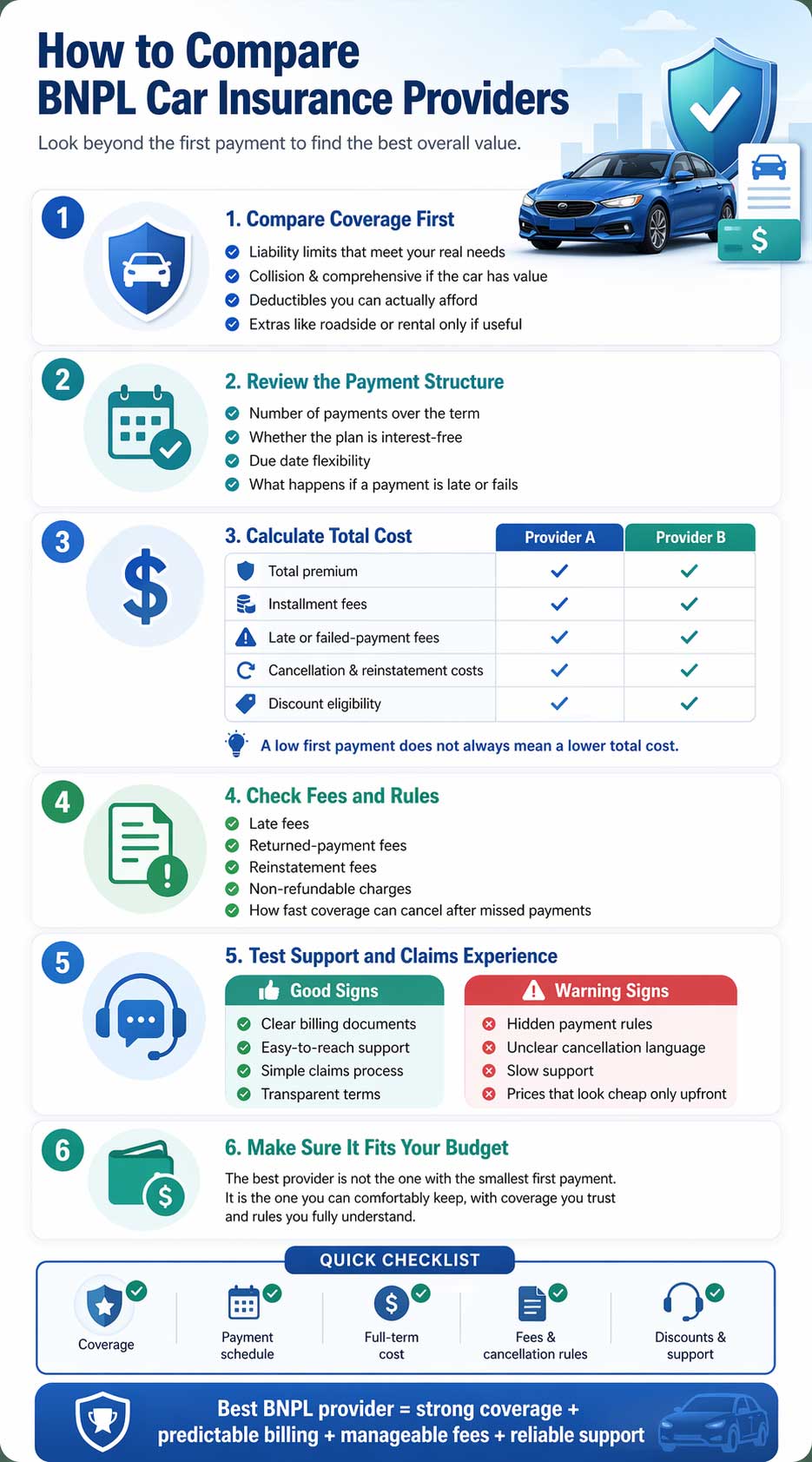
    Infographic explaining how to compare BNPL car insurance providers by coverage, payment structure, total cost, fees, support, discounts, and budget fit.

    Start With Coverage First, Not the Payment Plan

    BNPL changes how you pay, not what auto insurance is supposed to protect. Before you compare providers, decide what coverage you actually need. That usually means reviewing liability limits, deductibles, collision and comprehensive needs, and any extras such as roadside assistance or rental reimbursement.

    • Liability coverage: the legal foundation in most states and often the most important place to avoid going too low.
    • Collision and comprehensive: more relevant if your vehicle has enough value that you would struggle to replace it out of pocket.
    • Deductibles: lower deductibles mean more protection at claim time, but usually a higher premium.
    • Optional extras: only add value if you would realistically use them.

    Compare the Payment Structure Carefully

    Not all BNPL-style insurance billing works the same way. Some plans feel like short installment cycles, while others function more like standard monthly payments with a lighter starting burden. That is why you should compare the actual payment rhythm, not just the marketing language.

    Questions to Ask Every Provider

    • How many payments will I make over the term?
    • Is the plan truly interest-free, and under what conditions?
    • Can I change the due date if it does not match my payday?
    • What happens if a payment fails or is delayed?

    What Good Billing Looks Like

    • Clear due dates shown before you enroll.
    • Straightforward fee disclosures.
    • Reasonable handling of failed or late payments.
    • A schedule that matches your actual cash flow.

    Always Compare Total Cost, Not Just the First Month

    Low monthly pricing can be misleading if you only look at the first payment. A plan may feel cheaper upfront but cost more once installment charges, billing fees, or penalties are added. You should compare the full cost across the term and also look at what happens if you cancel early or miss a payment.

    If you want a focused breakdown of where extra charges usually appear, review hidden fees in BNPL car insurance and keep BNPL car insurance fees: what to expect open while you compare providers.

    What to Compare Why It Matters What to Ask
    Total premium A low first payment does not tell you the full cost. What will I pay over the entire term?
    Installment fees Monthly convenience can quietly raise the total price. Is there a charge for paying over time?
    Late and failed-payment fees One bad month can make the plan much more expensive. What happens if a payment is late or declined?
    Cancellation and reinstatement rules These rules affect what happens when coverage is interrupted. How fast can a policy cancel, and what does it cost to restore it?
    Discount eligibility Discounts can completely change which provider is the best value. Which discounts apply to me right now?

    Verify Fees, Penalties, and Cancellation Rules

    Fees are often the make-or-break part of a BNPL comparison. A provider with clear terms and manageable penalties may be far better than one with a cheaper-looking first payment but aggressive billing rules. Always confirm:

    • Late payment fees
    • Returned or failed payment fees
    • Reinstatement fees
    • Non-refundable charges
    • How quickly the policy can cancel after missed payments

    Check the Discounts You Can Actually Use

    Discounts can change the ranking of providers fast. Ask for a list of discounts and confirm which ones apply to your profile instead of assuming they are automatic. For younger or newer drivers, it helps to review car insurance discounts for young drivers before comparing quotes side by side.

    Common discount areas to ask about include student status, driver training, telematics, safety features, low mileage, autopay, and multi-car eligibility.

    Test the Claims Experience and Support Before You Buy

    Price matters, but service matters too. A provider with confusing billing support or weak claims handling can create extra stress when you actually need help. Before you choose, look at whether the provider is easy to reach, how documents are submitted, how billing disputes are handled, and how clearly policy changes are explained.

    Signs of a Strong Provider Experience

    • Easy-to-find billing and policy documents.
    • Clear explanations of terms and fees.
    • Fast response options by phone, chat, or email.
    • Simple document upload and claims processes.

    Warning Signs

    • Hard-to-find payment rules.
    • Unclear cancellation language.
    • Support that is slow or difficult to reach.
    • Pricing that looks low only because the real fees appear later.

    Make Sure the Plan Fits Your Real Budget

    BNPL is safest when the installments still feel manageable if something in your month changes. A payment plan that is already tight can become expensive fast after one missed payment. If you are unsure whether the schedule fits your cash flow, do a reality check with Is BNPL right for your budget?.

    “The best provider is not the one with the smallest first payment. It is the one you can comfortably keep, with coverage you can trust and rules you fully understand.” Practical takeaway for comparing BNPL car insurance providers

    FAQ

    What is BNPL car insurance?

    It usually refers to a payment structure that lets you spread policy costs over time instead of making a larger payment at the start.

    How do I find the best BNPL car insurance provider?

    Compare coverage first, then total cost, fee rules, discount eligibility, and the provider’s claims and billing support experience.

    Are there extra fees with BNPL plans?

    Sometimes. Common examples include installment charges, late fees, failed-payment fees, and reinstatement costs, depending on the provider.

    Is BNPL a good option for first-time drivers?

    It can be, but only if the payment schedule fits your budget and the policy still provides the coverage you actually need.

    Key Takeaways

    Compare coverage first, then payment structure. Always price the full term, verify fees and cancellation rules, confirm the discounts you truly qualify for, and favor providers with a solid support experience over ones that only look cheap on the first screen.

  • Common Car Insurance Discounts for Young Drivers Explained

    Created on February 1, 2026 • Updated on April 22, 2026

    Young drivers usually pay more for car insurance because insurers see limited driving history as a higher-risk profile. The good news is that several discounts are commonly available, and in many cases they can stack together. The smartest approach is to focus on the discounts that are easiest to verify and most consistently offered: good student, driver training, telematics, multi-car, vehicle safety, and low-mileage savings.[1][2]

    This page focuses on the most common discounts young drivers can realistically qualify for, plus a practical comparison checklist. If you want a broader overview of savings angles, keep this companion page open too: car insurance discounts for young drivers.

    Best First Discount

    Good-student discounts are often one of the simplest high-value savings opportunities for qualifying teens and college students.

    Best Skill-Based Discount

    Driver training and defensive driving discounts can help newer drivers save while also improving confidence behind the wheel.

    Best Ongoing Savings Tool

    Telematics can reward safe habits over time, especially for drivers who brake smoothly, avoid risky driving hours, and keep mileage lower.

    Quick takeaway: the biggest savings usually come from stacking realistic discounts, not from chasing one flashy offer.

    Why Young Drivers Get Higher Rates

    Most pricing comes down to risk signals. Insurers look at age and driving experience because newer drivers have less established history behind the wheel. That is why discounts matter so much early on: they are one of the fastest ways to offset a higher starting premium without reducing important coverage.[1][2]

    The Most Common Discounts Young Drivers Can Actually Qualify For

    Core Discounts to Ask About

    • Good student discount: often available for qualifying high school or college students with solid grades.
    • Driver training discount: may apply if an approved education course is completed.
    • Telematics discount: can reward safe driving patterns tracked by an app or device.
    • Multi-car discount: often helpful when staying on a household or family policy.

    Other Savings Worth Checking

    • Vehicle safety feature discounts: for cars with safety or anti-theft equipment.
    • Low-mileage discount: for drivers with shorter commutes or lighter annual use.
    • Paperless or autopay discount: offered by some carriers.
    • Paid-in-full savings: can reduce total cost if monthly billing adds fees.

    If you are also trying to keep the start-up cost lower, compare these savings with flexible-payment options such as affordable no down payment car insurance discounts.

    Good Student, Training, and Telematics: Which One Matters Most?

    Good-student discounts are often the easiest to document. Many insurers ask for a report card, transcript, or proof of academic standing. Driver training discounts can be valuable too, especially for brand-new drivers, but you should always confirm which courses count before enrolling. Telematics can produce strong savings for careful drivers, but it is not ideal for everyone because driving patterns such as late-night trips or heavy traffic can affect results.[3][4]

    Discount Type Why It Helps What You Usually Need Main Watch-Out
    Good Student One of the clearest savings paths for eligible students Proof of grades or school status Requirements vary by insurer
    Driver Training Can lower costs while improving driving skills Approved course completion certificate Not every course qualifies everywhere
    Telematics / Safe Driving App Can reward careful driving habits directly Participation in an app or device-based program Some driving patterns may reduce the benefit
    Multi-Car / Family Policy Often lowers cost without cutting coverage Eligibility on a shared household policy Always compare both solo and family-policy pricing

    About “Tattoo-Free” Discounts

    Some websites mention “tattoo-free” discounts, but that is not a standard widely advertised auto insurance discount category. In practice, this is better treated as a call-and-confirm item rather than something you should assume is available across the market. To keep topics separated and avoid cannibalization, that angle should stay concentrated on your dedicated page: tattoo-free insurance discounts for young drivers.

    How to Compare Quotes Without Getting Tricked by Low Monthly Pricing

    A quote can look cheap at first because the opening monthly payment is low, but that does not tell you the full story. Compare the same limits, deductibles, and total term cost side by side. You should also check whether the insurer charges installment fees, late fees, or reinstatement fees if you are not paying in full.[1]

    • Coverage limits: make sure the policies are truly comparable.
    • Deductibles: lower premium often means higher out-of-pocket risk.
    • Total 6- or 12-month cost: not just the first month.
    • Billing fees: monthly payment convenience can add cost.

    If you are using a flexible payment plan, keep this guide handy too: BNPL car insurance fees: what to expect.

    Quick Checklist to Ask Any Insurer

    Ask About Eligibility

    • Which discounts apply to my profile right now?
    • What proof do you need for each one?
    • Do discounts stack together?
    • Which savings stop at renewal or after a certain age?

    Ask About Cost Structure

    • Are there installment or monthly billing fees?
    • Does paying in full reduce the total cost?
    • When can the price change?
    • What happens if a payment is late?
    “The best discount strategy for a young driver is usually simple: stack the savings you can prove, then compare the full policy cost instead of chasing the lowest first payment.” Practical takeaway for first-time and younger drivers

    FAQ

    What is usually the best discount for young drivers?

    Good-student discounts are often one of the easiest and most valuable starting points, but the biggest total savings usually comes from combining multiple discounts.

    Can a defensive driving course lower my premium?

    Yes, many insurers offer training-related discounts, especially for newer drivers, but you should confirm the course qualifies before paying for it.

    Do discounts stack?

    Many do, but not always. Some insurers limit combinations, so it is important to ask directly.

    Is it cheaper to stay on a parents’ policy?

    Often it can be, especially with multi-car savings, but you should still compare both household and individual quotes before deciding.

    Final Thoughts

    The fastest way for a young driver to reduce insurance costs is usually by stacking realistic discounts such as good student, driver training, telematics, and multi-car eligibility where possible. After that, the next biggest lever is comparing the full cost carefully and avoiding fee-heavy billing structures.

    If you want to compare discount eligibility with flexible-payment options, this page can help: affordable no down payment car insurance discounts.

  • No Down Payment Car Insurance Options: What’s Really Affordable?

    Created on October 15, 2025 • Updated on April 22, 2026

    No down payment car insurance sounds attractive because it reduces the amount you need to pay at the start of coverage, but the best choice depends on more than just getting insured today. Drivers still need to compare coverage levels, total premium, billing structure, and any added service or installment charges. Consumer shopping guidance consistently encourages comparing the full policy rather than focusing on a single headline payment.[1][2]

    Some shoppers reach these options through flexible installment-based structures similar to buy now pay later car insurance, where coverage can begin while costs are spread over time. If you are still checking eligibility basics, review top tips to qualify for BNPLCI before comparing plans.

    Fast Access to Coverage

    Lower upfront cost can make it easier to start legally required coverage when paying a larger initial deposit would be difficult.

    Total Cost Still Matters

    A smaller amount due today does not automatically mean the policy is cheaper over the full term.

    Fees Can Change the Deal

    Monthly billing, installment handling, and late-payment penalties can all affect the real cost of a flexible plan.

    Quick takeaway: the best no down payment option is usually the one that balances immediate affordability with clear terms, realistic payments, and coverage you can actually rely on.

    Understanding the Types of Coverage

    Before choosing any no down payment policy, make sure you understand what protection you are actually buying. Payment flexibility does not replace the need to compare coverage levels carefully. A cheaper entry point is not helpful if the policy leaves you underinsured after an accident or loss.[1]

    • Liability coverage: usually required by state law and pays for bodily injury or property damage you cause to others.
    • Collision coverage: helps pay for damage to your vehicle after a covered crash, regardless of fault.
    • Comprehensive coverage: helps with non-collision losses such as theft, vandalism, hail, or fire.
    • Uninsured or underinsured motorist coverage: may help if the other driver has little or no insurance, depending on your state and policy.

    Financial Implications of No Down Payment Insurance

    The main advantage is obvious: you may be able to start coverage with less cash upfront. But the tradeoff is that the cost may be redistributed into future installments, extra billing charges, or stricter payment terms. NAIC consumer materials specifically advise shoppers to ask about payment options and whether paying monthly or quarterly adds an extra charge.[3]

    That is why it is important to look beyond the phrase “no down payment.” The real question is what the full policy will cost after all installments, fees, and penalties are included. For a closer look at possible add-on costs, see hidden fees in BNPL car insurance.

    What Can Raise the Real Cost

    • Installment or service fees tied to split payments.
    • Late-payment penalties and failed-payment charges.
    • Higher monthly amounts spread across the term.
    • Reinstatement costs if coverage lapses.

    What to Confirm Before You Buy

    • The full premium for the entire policy period.
    • How many payments are due and on what dates.
    • Whether monthly billing costs more than paying in full.
    • What happens if a payment is missed or delayed.

    Assessing Your Risk Profile

    Your premium is still shaped by the same core underwriting factors used in standard auto insurance shopping. Those usually include your driving history, age and experience, location, vehicle, prior claims, and the coverage structure you choose. No down payment availability may help with timing, but it does not remove the effect of your underlying risk profile.[1][3]

    If you want to compare these flexible arrangements more broadly, explore buy now pay later car insurance options and look at the full cost, not just the first payment.

    Provider Reputation and Customer Service

    Flexible payment terms are only part of the picture. Provider reliability matters too. A plan that looks affordable can become frustrating if billing support is unclear, policy documents are hard to understand, or customer service is difficult to reach when a payment problem comes up.

    This is why you should compare complaint patterns, transparency, and how clearly the provider explains fees and payment rules. If you are reviewing immediate coverage models, affordable coverage without a down payment can help frame what to look for in a more budget-focused plan.

    Policy Comparison and Coverage Analysis

    Side-by-side comparison is one of the most practical ways to avoid a poor choice. Consumer guidance recommends comparing the same limits, deductibles, and features across carriers so you are not fooled by a low upfront amount attached to weaker coverage or less favorable billing terms.[2]

    What to Compare Why It Matters Questions to Ask
    Monthly premium A low first payment may be followed by higher ongoing costs. What is the full policy cost after all payments?
    Coverage limits Lower limits may make a quote look cheaper while reducing protection. Am I comparing the same coverage across providers?
    Deductibles Higher deductibles can lower premiums but increase out-of-pocket risk. Could I actually afford the deductible after a claim?
    Billing fees Installment charges can raise the total cost quietly over time. Is there an extra fee for paying monthly?
    Penalty rules Late-payment terms can quickly turn a flexible plan into an expensive one. What happens if I miss or delay a payment?

    For a more structured side-by-side review, use the BNPL car insurance comparison guide.

    Discounts to Look For

    Even if you need a no down payment structure, you should still ask about every discount you may qualify for. NAIC and insurer materials commonly point shoppers toward discounts related to safe driving, bundling, paperless billing, training, or student eligibility, depending on the provider.[4]

    • Multi-policy discounts for bundling auto with other insurance.
    • Safe-driver savings for cleaner records and lower-risk profiles.
    • Student, training, or affiliation discounts when available.
    • Paperless or autopay savings if the provider offers them.

    Using Flexible Payment Plans Responsibly

    Flexible billing can be useful, but it works best when the schedule truly fits your budget. The CFPB’s BNPL reporting highlights that installment-based consumer finance can create extra stress when shoppers focus on convenience first and repayment obligations later.[5]

    A few basic habits make a big difference:

    • Pick a payment schedule that matches your income pattern.
    • Track due dates and keep your payment method updated.
    • Review each statement for new or unexpected charges.
    • Avoid stretching your budget just because the initial payment is low.

    For practical budgeting guidance, review how to use buy now pay later responsibly.

    “The best no down payment policy is not just the one that starts today. It is the one you can afford to keep.” Practical takeaway for budget-focused drivers

    FAQ

    What is no down payment car insurance?

    It generally refers to a policy or payment structure that lets coverage begin without a large upfront deposit, with costs spread into scheduled payments instead.

    Are there drawbacks to no down payment policies?

    Yes. Some plans may have higher monthly costs, installment fees, or stricter penalty rules if payments are missed.

    Does a lower upfront payment always mean the policy is cheaper?

    No. You need to compare the total premium, all billing fees, and the full payment schedule to know the real cost.

    Where can I compare providers more carefully?

    You can start with the BNPL car insurance comparison guide and then review full coverage details before choosing a plan.

    Conclusion

    Choosing no down payment car insurance requires more than finding a low amount due at checkout. The strongest decision usually comes from comparing coverage types, provider transparency, total cost, billing fees, and your ability to maintain the payment schedule over time.

    If you want to explore flexible options that fit your budget more carefully, visit BNPLCI and continue comparing plans with the full cost in mind.