Category: BNPL Car Insurance

  • Do Tattoos Affect Car Insurance Rates? Myths vs Facts for Young Drivers

    Created on October 15, 2025 • Updated on April 22, 2026

    Tattoos do not appear in mainstream auto insurance consumer guidance as a standard pricing factor, and they are not presented by major insurer discount pages as a standard discount category either. In practice, insurers usually focus on things like driving record, age and experience, vehicle, location, coverage choices, and established savings categories such as good-student, driver training, and usage-based programs.[1][2][3]

    That means “tattoo-free discount” language should usually be treated as a promotional or site-specific marketing idea, not as a normal industry underwriting rule. If you want to explore that angle further, you can still review tattoo-free insurance discounts, but the smartest way to save is still to concentrate on the factors insurers clearly document.

    For young drivers balancing price and accessibility, the more practical question is often how to combine real discounts with manageable payment timing. That is where guides such as BNPL-style insurance programs and tips to qualify for BNPLCI programs can be more useful than myth-based pricing claims.

    Myth vs Reality

    Auto insurance pricing is generally built around measurable risk and policy details, not appearance-based assumptions.

    Real Savings Paths

    Good-student discounts, driver training, telematics, bundling, and safe-driving behavior are usually the savings categories worth checking first.

    Budget Still Matters

    Even when the price is reasonable, flexible payment timing can make a big difference for first-time and younger drivers.

    Quick takeaway: if a promotion talks more about image than about actual underwriting factors, read the terms carefully and compare it with standard discounts that insurers openly publish.

    What Actually Affects Auto Insurance Pricing

    If you are trying to understand what changes your premium, it helps to focus on the categories insurers and regulators repeatedly mention. Standard consumer materials emphasize that premiums are tailored based on the information collected in the quote process, and common rating influences include your driving history, location, vehicle, coverage selections, and other documented risk indicators.[4][5]

    • Driving record: accidents, tickets, and claims can affect rates.
    • Age and experience: younger and newer drivers often pay more at first.
    • Vehicle details: repair cost, safety equipment, and theft risk matter.
    • Where you live: traffic patterns, theft rates, and local claims history can matter.
    • Coverage structure: deductibles, limits, and optional coverages change the premium.
    • Program participation: some discounts depend on grades, training, or telematics enrollment.

    Why “Tattoo-Free Discount” Claims Should Be Reviewed Carefully

    The most important point is that “tattoo-free” is not commonly listed alongside the standard discount types promoted in mainstream insurer materials. NAIC and major insurer pages more often highlight good-student discounts, driver training, multi-policy or multi-car savings, and telematics or usage-based programs instead.[2][3][4]

    That does not automatically mean every promotion using that phrase is fake. It means you should treat it like any other marketing offer: verify the terms, confirm whether it changes the premium or only the payment structure, and ask whether the offer can be combined with more established discounts.

    Good Questions to Ask

    • Is this a true premium discount or just a promotional label?
    • Does it reduce the total policy cost or only the amount due today?
    • Can it be combined with student, training, or telematics savings?
    • Are there extra fees or special conditions tied to the offer?

    Red Flags to Watch

    • The promotion is described clearly, but the fee schedule is not.
    • The site focuses on the headline savings without explaining eligibility.
    • The offer sounds appearance-based instead of risk-based.
    • The terms are missing or only shown late in the application process.

    Discounts Young Drivers Should Check First

    Young drivers usually get the most value from discount categories that are already widely recognized. NAIC materials point to good-student and defensive driving or driver education discounts, while insurer pages also highlight teen-driver, student, and safe-driving options. Usage-based insurance can add another path for careful drivers who are comfortable with monitored driving programs.[6][7][8]

    Option How to Think About It Who It Often Helps Main Check Before You Enroll
    Tattoo-Free Promotion Not a standard industry discount category Only shoppers using a site or provider that markets it Verify whether it changes premium, fees, or just payment presentation
    Good-Student Discount Well-established savings category for qualifying students Students with the required grades or school status Ask what proof of eligibility is required
    Driver Training / Defensive Driving Common discount category for younger or newer drivers Drivers who complete approved education or training Confirm the course is accepted by the insurer
    Usage-Based / Telematics Can reward safer driving behavior with personalized pricing Drivers comfortable with monitored driving data Understand what data is tracked and how it may affect rates

    How Usage-Based Insurance and Student Discounts Fit In

    Usage-based insurance, also called telematics, works by using a device or app to measure driving behavior such as miles driven, time of day, hard braking, and rapid acceleration. That can matter for younger drivers because it gives careful drivers another way to show lower risk beyond simply waiting for more years of driving experience.[9]

    Good-student discounts remain another practical path because they are easier to understand and often require simple documentation. Progressive and State Farm both describe student-related discount programs, while State Farm also highlights Steer Clear for teen and young adult drivers looking to improve skills and potentially earn savings.[6][7][8]

    Where Flexible Payment Options Can Still Help

    Even after you find legitimate discounts, affordability still depends on payment timing. A lower monthly burden can matter just as much as the premium itself, especially for newer drivers managing school, part-time work, or a first full-time job. That is one reason some shoppers explore pay-over-time models through BNPL-related insurance content.

    If you are comparing flexible-payment structures, it helps to understand how they work before you apply. Start with what Buy Now Pay Later car insurance is, then compare transparency, total cost, and fees on BNPLCI.

    “The strongest savings strategy is usually not chasing myths. It is stacking the discounts you truly qualify for and choosing a payment structure you can manage.” Practical takeaway for young drivers

    FAQs

    Do tattoos affect car insurance rates?

    Mainstream consumer guidance and insurer discount pages do not present tattoos as a standard rating factor for auto insurance pricing.

    Are tattoo-free discounts standard in auto insurance?

    No. They should generally be treated as promotional or site-specific marketing language rather than a standard industry discount category.

    What discounts usually matter more for young drivers?

    Good-student discounts, driver training or defensive driving discounts, telematics programs, and other standard savings categories are usually more established and easier to verify.

    Can I still look at BNPL-style payment options?

    Yes, but compare the full premium, fees, billing schedule, and all available standard discounts before deciding.

    Conclusion

    Tattoos do not appear to be a standard auto insurance pricing factor, and “tattoo-free discount” language is best viewed as promotional framing rather than a mainstream underwriting rule. For young drivers, the more dependable savings path is usually straightforward: focus on real discount categories, keep your documentation ready, compare providers carefully, and choose a payment plan you can actually maintain.

    If you want to keep exploring affordability options, start with tattoo-free insurance discounts, then review broader payment and eligibility guides on BNPLCI.

  • BNPL Car Insurance Fees: What to Expect

    Editorially reviewed informational content about U.S. car insurance fees, installment billing, BNPL-style payment schedules, and flexible auto insurance payment options.

    BNPL car insurance fees guide

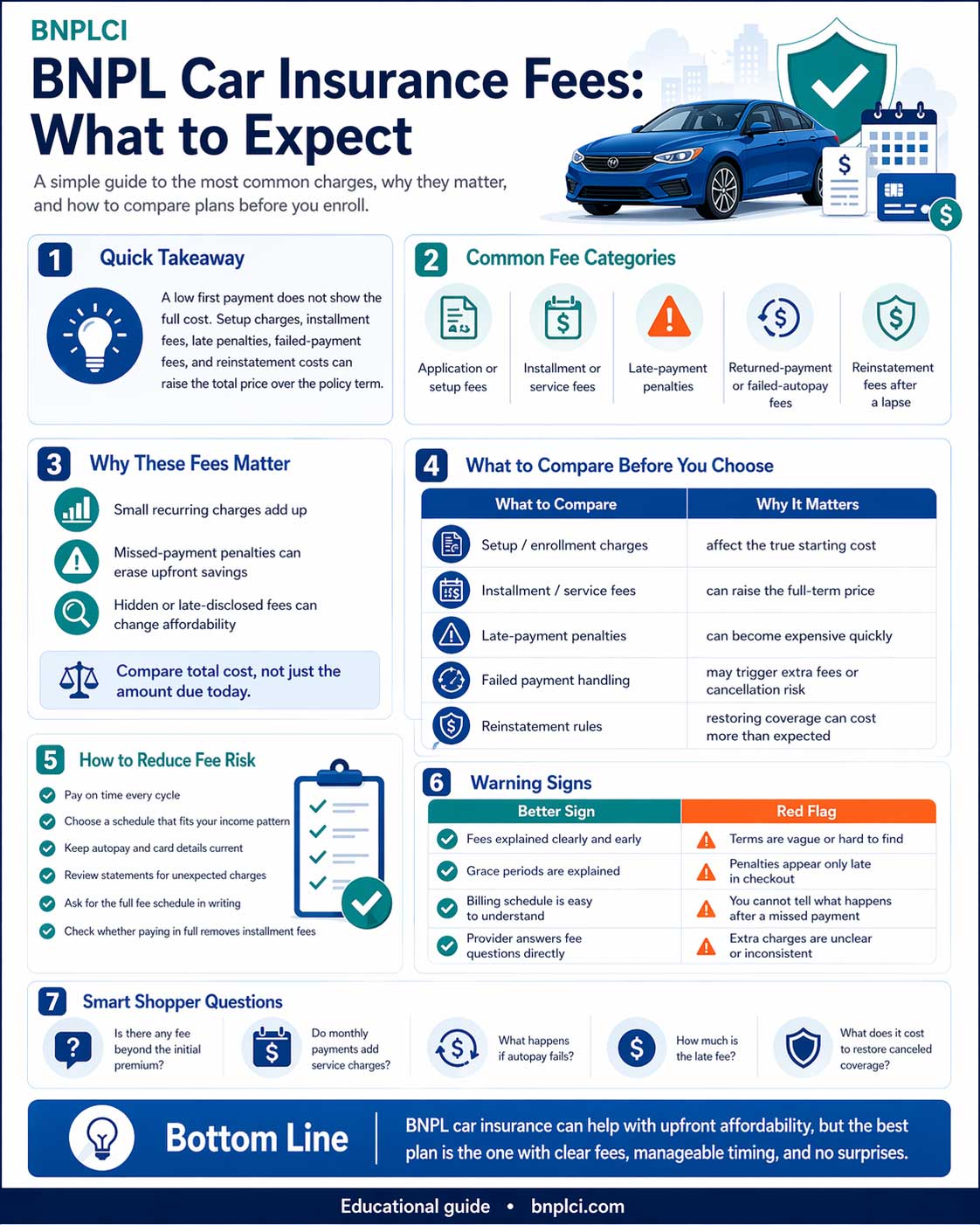
    BNPL car insurance fees are the extra charges that may appear when an auto insurance policy is paid over time instead of paid mostly upfront. These fees can show up before coverage starts, during monthly billing, after a late or failed payment, or when a canceled policy must be reinstated.

    This guide explains what fees to expect at each stage of a BNPL-style or flexible car insurance payment plan. The goal is to help you compare the first payment, the full-term premium, installment charges, late-payment rules, returned-payment fees, cancellation timing, and reinstatement costs before choosing a policy.

    The lowest amount due today is not always the cheapest policy overall. Auto insurance should still be compared by coverage limits, deductibles, total premium, company rules, and the full payment schedule.[1][2]

    Before Coverage Starts

    Expect to verify the first amount due, setup charges, payment method rules, and whether any fee is refundable.

    During Billing

    Installment, service, convenience, or processing fees may affect the real cost of spreading payments over time.

    After Payment Problems

    Late, failed-payment, cancellation, or reinstatement charges can appear if the schedule is interrupted.

    Quick takeaway: the best way to compare BNPL car insurance fees is to ask what happens before signup, during each payment cycle, and after any missed or failed payment.
    Infographic explaining BNPL car insurance fees to expect before coverage starts, during monthly billing, after failed payments, and during cancellation or reinstatement.

    BNPL Car Insurance Fees to Expect Before, During, and After Coverage Starts

    A BNPL-style auto insurance plan can make coverage easier to start because the first amount due may be lower than a traditional upfront payment. The tradeoff is that the total cost can depend on several fee categories. Some fees appear when the policy begins. Others appear each month. Some only appear if a payment is late, returned, or missed.

    The table below separates the main fee stages so the page stays focused on what a driver should expect, where the fee may appear, and what to ask before enrolling.

    Stage Fee to Expect Where It May Appear What to Ask Before Choosing
    Quote or Signup Application, setup, enrollment, or payment-plan fee Quote screen, checkout page, agency paperwork, or billing agreement Is this fee part of the premium, separate from the premium, or refundable?
    Policy Activation First installment, initial premium, taxes, or required startup payment Amount due today before coverage starts What exact amount must be paid before the policy is active?
    Monthly Billing Installment, service, convenience, or processing fee Billing schedule, monthly invoice, or payment portal Is this charged once, monthly, or with every payment?
    Autopay or Card Payment Card processing, returned-payment, failed-autopay, or bank-return fee Payment method terms or failed payment notice Can one failed payment trigger both a fee and cancellation notice?
    Late Payment Late fee or penalty Billing terms, late notice, or cancellation warning When is the payment considered late, and is there a grace period?
    Cancellation or Lapse Cancellation, short-rate, reinstatement, or restart fee Cancellation notice, reinstatement offer, or revised bill What does it cost to restore coverage if the policy cancels?
    Policy Changes Endorsement, document, broker, or administrative fee Policy change confirmation or agency invoice Are there charges for changing vehicles, drivers, addresses, or coverage?

    Fees Before Coverage Starts

    The first fee stage happens before the policy is active. A driver may see an application fee, setup fee, agency fee, enrollment fee, payment-plan charge, or first installment. These charges matter because they decide whether the advertised “low upfront” option is actually affordable today.

    The most important question is simple: what exact amount must be paid before coverage begins? If the quote separates premium, taxes, installment charges, and agency fees, compare the full amount due today instead of only the monthly number displayed in the ad.

    • Ask whether the startup fee is part of the premium or separate from it.
    • Ask whether any application or agency fee is refundable.
    • Confirm the policy effective date before driving.
    • Save the quote, payment schedule, and proof of insurance.

    Fees During Monthly Billing

    The second fee stage happens after coverage starts. Many flexible payment plans divide the premium into scheduled installments, but monthly billing may include installment, service, convenience, or processing charges. A small fee can look harmless on one bill, but it can add up across a six-month or twelve-month term.

    Some state-level insurance guidance recognizes that installment premium payment plans can involve fees, but rules vary by state and by insurer. That is why the safest approach is to ask for the full billing schedule before agreeing to the policy.[3]

    Charges to Look For

    • Monthly installment fee.
    • Payment processing fee.
    • Convenience fee for card payments.
    • Paper billing or document fee.
    • Broker or agency service fee.

    What to Compare

    • Total premium with fees included.
    • Monthly payment amount after all charges.
    • Whether autopay lowers or removes a fee.
    • Whether paying in full avoids installment charges.
    • Whether fees are shown clearly before signup.

    Fees After a Late or Failed Payment

    The third fee stage appears when a scheduled payment does not go through on time. This is where a flexible plan can become expensive quickly. A missed payment may create a late fee, a returned-payment fee, a failed-autopay fee, a cancellation notice, or a reinstatement charge if coverage stops and must be restored.

    BNPL products are generally designed to split payments over time, and the CFPB has noted that consumer understanding and disclosure can be important issues in BNPL markets.[4] Auto insurance billing is not always identical to retail BNPL, but the same practical rule applies: read the payment terms before relying on the low first payment.

    Important: one failed payment can create more than one problem. It may trigger a fee, a cancellation notice, a coverage lapse, or a requirement to pay more before the policy can be restored.
    • Ask when a payment is considered late.
    • Ask whether there is any grace period.
    • Ask whether failed autopay creates a separate returned-payment fee.
    • Ask whether the insurer sends a cancellation notice after nonpayment.
    • Ask how much must be paid to reinstate the policy after a lapse.

    Cancellation and Reinstatement Fees

    Cancellation and reinstatement are especially important because the cost is not only financial. If your auto insurance cancels for nonpayment, you may lose active coverage. Depending on your state, vehicle, and situation, that can create legal, lender, registration, or future insurance problems.

    A reinstatement fee may apply when the provider allows a canceled policy to be restored. In some cases, the driver may need to pay the missed amount, a fee, and possibly a new down payment or rewritten policy amount. The exact process depends on the insurer, state, and timing of the cancellation.

    Scenario Possible Cost Why It Matters Question to Ask
    Late payment Late fee or penalty Raises the cost of that billing cycle. How many days after the due date does the fee apply?
    Returned payment Bank-return, NSF, or failed-payment fee A failed payment can create extra charges even if you try to pay again. Can a declined card or failed bank draft trigger a fee?
    Cancellation notice Amount needed to keep coverage active You may need to pay quickly to avoid a lapse. How much time do I have before coverage stops?
    Reinstatement Missed payment plus possible reinstatement fee Restoring coverage can cost more than simply staying current. Is reinstatement guaranteed or subject to approval?
    New policy after lapse New first payment or higher quote A lapse can make future shopping harder or more expensive. Would a canceled policy require a new application?

    How to Calculate the Real Cost of BNPL Car Insurance Fees

    The real cost is not only the amount due today. A better calculation includes the first payment, all scheduled installments, monthly service charges, payment processing fees, and any likely penalty charges. This helps you compare a low-upfront plan against a traditional installment plan or pay-in-full option.

    1 Start with the full premium

    Ask for the total premium over the full policy term. Do not compare one quote’s first payment against another quote’s full premium. Keep liability limits, deductibles, and optional coverages as similar as possible when comparing policies.

    2 Add recurring billing charges

    Add every installment, service, processing, or convenience fee that appears in the payment schedule. If a fee is charged every month, multiply it by the number of payments in the term.

    3 Compare the full-term number

    Compare the total paid by the end of the policy term. A BNPL-style option may still be worth it if cash flow is your main problem, but the decision should be based on the full cost, not only the startup amount.

    Questions to Ask Before Enrolling

    The NAIC’s consumer shopping guidance encourages shoppers to compare policy details carefully instead of relying on one headline number. That same approach applies to BNPL-style fees: compare the payment terms, not only the advertised first payment.[5]

    Question Why It Matters Better Answer to Look For
    What exactly is due today? Some offers show a low first payment but add fees before activation. A clear total that includes premium, taxes, fees, and payment-plan charges.
    What fees apply every month? Recurring charges can raise the full-term cost. A complete schedule showing each payment and each fee.
    Can I avoid fees by using autopay? Some billing methods may cost less than others. Clear explanation of whether autopay reduces, adds, or removes charges.
    What happens if my payment fails? A failed payment can cause fees and cancellation risk. Written terms for returned payments, late fees, and cancellation notices.
    What does reinstatement cost? Restoring coverage after cancellation can be expensive or unavailable. A clear reinstatement process before you enroll.
    Would paying in full be cheaper? Some installment fees may be avoided with full payment. A side-by-side quote showing pay-in-full versus installment billing.

    When BNPL Car Insurance Fees May Still Be Worth It

    Fees are not automatically a reason to reject a BNPL-style payment plan. For some drivers, a lower upfront amount can be useful if they need coverage quickly, are avoiding a lapse, or need to preserve cash for other urgent expenses. The key is knowing the cost before you agree.

    Reasonable Use Cases

    • You need proof of insurance quickly.
    • You cannot comfortably pay a larger upfront amount.
    • You understand the full payment schedule.
    • The fees are clear and manageable.
    • The coverage level still fits your needs.

    Reasons to Be Careful

    • The provider does not explain fees clearly.
    • The monthly payment already feels too high.
    • Late-payment rules are strict or unclear.
    • Reinstatement terms are missing.
    • The total cost is much higher than other quotes.

    Related BNPLCI Guides

    FAQ

    What fees should I expect with BNPL car insurance?

    You may see setup fees, application fees, installment fees, payment processing fees, late-payment fees, returned-payment fees, cancellation charges, or reinstatement costs. The exact fee structure depends on the insurer, provider, state, and payment plan.

    Are BNPL car insurance fees the same as hidden fees?

    No. This page focuses on fees you should expect and ask about before enrolling. Hidden fees are charges that may be unclear, poorly disclosed, or easy to miss during the quote or checkout process.

    Can installment fees make car insurance more expensive?

    Yes. A policy with a lower first payment can cost more overall if it includes recurring installment or service charges. Always compare the total paid over the full policy term.

    What happens if I miss a BNPL car insurance payment?

    A missed payment may trigger a late fee, returned-payment fee, cancellation notice, lapse, or reinstatement requirement. The exact consequences depend on the policy terms and state rules.

    How can I reduce BNPL car insurance fees?

    Ask for all fees in writing, choose a realistic payment schedule, keep payment information current, use autopay only if it fits your budget, and compare whether paying in full would reduce service charges.

    Should I choose the plan with the lowest first payment?

    Not automatically. The lowest first payment may not be the best value if the full-term cost, fees, coverage limits, or cancellation rules are worse than another option.

    Conclusion

    BNPL car insurance fees can appear before coverage starts, during monthly billing, after a failed payment, or when a canceled policy must be reinstated. That is why the smartest comparison is not only the first payment. It is the full cost of the policy after every expected charge is included.

    Before choosing a flexible payment plan, ask for the full premium, the amount due today, the complete payment schedule, all recurring fees, late-payment rules, failed-payment consequences, and reinstatement terms. A BNPL-style plan can be useful, but only when the fee structure is clear and the payment schedule is realistic.

  • Buy Now Pay Later Car Insurance: Flexible Options

    Editorially reviewed informational content about U.S. car insurance payment options, low upfront payment structures, flexible billing, and BNPL-style insurance shopping.

    Flexible payment options guide

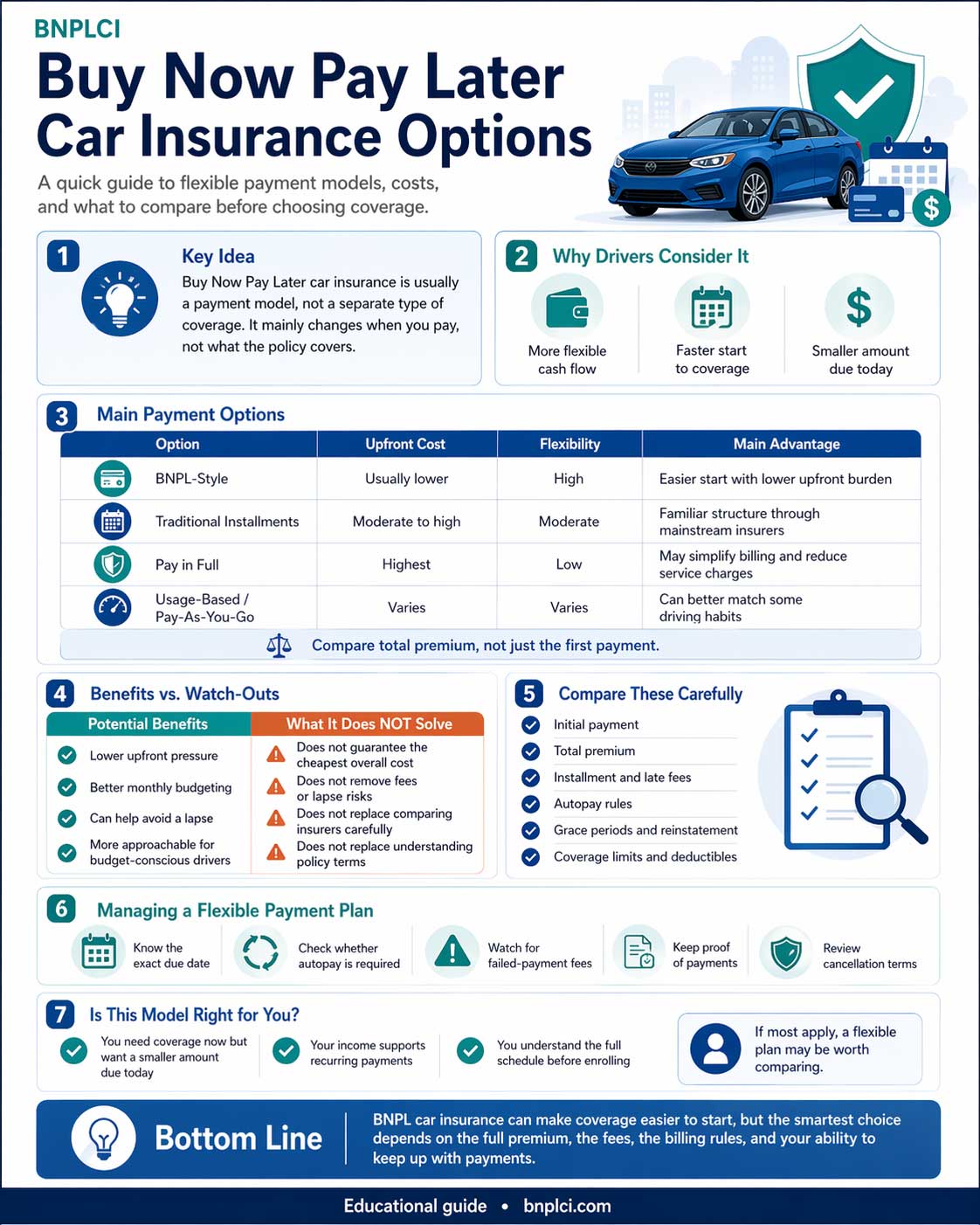
    Buy Now Pay Later car insurance options are best compared by looking at the full payment structure, not just the first amount due. Some drivers want a lower first payment, others want predictable monthly installments, and others may prefer usage-based or pay-in-full alternatives if those options lower the total cost.

    This guide compares the main BNPL-style and flexible auto insurance payment options side by side, including low first-payment policies, monthly installment plans, no-down-payment advertised plans, usage-based models, autopay billing options, and pay-in-full alternatives.

    The goal is not simply to find the smallest upfront number. The better approach is to compare coverage limits, deductibles, fees, cancellation rules, total premium, and payment due dates before starting a policy.[1][2]

    Compare Payment Types

    Look beyond one advertised payment and compare how each option handles deposits, installments, service fees, and renewal billing.

    Check the Total Cost

    A lower first payment may help today, but the full policy cost can still be higher if fees or less favorable terms apply.

    Match Your Budget

    The best option is the one you can keep active without missing payments, risking a lapse, or reducing coverage too much.

    Infographic comparing buy now pay later car insurance options, low first payment plans, monthly installments, no down payment advertising, usage based insurance, autopay billing, and pay in full alternatives.

    Buy Now Pay Later Car Insurance Options Compared

    The phrase “Buy Now Pay Later car insurance” is often used broadly. In practice, drivers may be comparing several different payment structures. Some are traditional auto insurance billing options with a lower amount due upfront. Others are installment arrangements, agency billing options, usage-based policies, or alternatives that reduce the total cost in a different way.

    The table below separates the main options so you can see what each one usually changes, who it may help, and what to review before choosing.

    Option How It Usually Works Best For Main Advantage Main Watch-Out
    Low First-Payment Car Insurance You start coverage with a smaller initial payment, then continue with scheduled payments. Drivers who need coverage now but cannot comfortably pay a large amount upfront. Can make starting a policy more manageable. The total policy cost may still be higher than a pay-in-full option.
    Monthly Installment Auto Insurance The premium is divided into monthly payments over the policy term. Drivers who prefer predictable recurring billing. Easier to fit into a monthly budget. Installment or service fees may apply.
    No-Down-Payment Advertised Plans Marketing may emphasize very low upfront cost, but some amount may still be due to activate coverage. Drivers searching for the lowest realistic amount due today. Can reduce the first payment barrier. “No down payment” does not always mean zero dollars due.
    Agency or Broker Payment Arrangements An agency, broker, or payment partner may help place coverage with a carrier and arrange billing terms. Drivers who want help comparing multiple providers or payment structures. May give access to more than one carrier or billing setup. Always review fees, cancellation terms, and who actually provides the insurance.
    Usage-Based or Pay-Per-Mile Insurance Pricing may depend partly on mileage, driving behavior, or telematics data. Low-mileage drivers or drivers comfortable with tracking-based programs. May lower costs for some drivers with limited driving. Pricing can vary based on driving patterns and program rules.
    Autopay or Electronic Billing Options You set up automatic payments or paperless billing, sometimes with a billing discount depending on the insurer. Drivers who are organized and want fewer missed-payment risks. Can simplify payment management. A failed payment can still create fees or cancellation risk.
    Pay-in-Full Alternative You pay the full policy premium upfront for the term. Drivers with enough cash available who want simpler billing. May avoid installment fees and reduce payment stress later. Requires the largest upfront payment.
    Quick takeaway: the best BNPL-style car insurance option is not always the one with the lowest first payment. It is the option that gives you enough coverage, a manageable payment schedule, and the lowest realistic total cost for your situation.

    Option 1: Low First-Payment Car Insurance

    Low first-payment car insurance is often the closest match for drivers searching for Buy Now Pay Later car insurance options. The idea is simple: instead of paying a large amount before coverage starts, you pay a smaller first amount and then continue with scheduled payments.

    This option may help if you need proof of insurance quickly, are switching providers, or are trying to avoid a lapse. However, the first payment should never be judged alone. Ask whether the lower upfront amount creates higher monthly payments, installment fees, or stricter cancellation rules later.

    • Ask how much is due today to activate coverage.
    • Compare the total six-month or twelve-month policy cost.
    • Check whether installment fees are added to each payment.
    • Confirm how quickly coverage could cancel after a missed payment.

    Option 2: Monthly Installment Auto Insurance

    Monthly installment billing is one of the most common flexible payment options. Instead of paying the whole premium upfront, the driver pays on a schedule. This can make insurance easier to budget because the cost becomes part of a monthly routine.

    The tradeoff is that monthly billing can include service charges or installment fees depending on the insurer and state. The monthly payment may look manageable, but the total amount paid over the policy term may be higher than a pay-in-full policy.

    When Monthly Installments May Help

    • You prefer predictable monthly bills.
    • You do not want one large insurance payment.
    • Your income arrives on a regular schedule.
    • You can keep track of payment due dates.

    What to Check First

    • Monthly service charges.
    • Autopay requirements.
    • Late-payment fees.
    • Cancellation and reinstatement rules.

    Option 3: No-Down-Payment Advertised Plans

    Some drivers search for no-down-payment car insurance because they want to start coverage with as little money as possible. The important point is that “no down payment” is often used as a marketing phrase. In many cases, a first payment may still be required to activate the policy.

    That does not mean the option is useless. It can still be helpful if the first required payment is lower than a traditional deposit. The key is to ask what the phrase means in the actual quote: zero dollars due, a reduced first payment, or simply the first month’s premium due at signup.

    Important: do not assume a “no down payment” quote means free coverage today. Auto insurance generally requires payment before or when coverage begins, and terms vary by insurer, state, driver profile, and billing structure.

    Option 4: Agency or Broker Payment Arrangements

    Some drivers work with agencies, brokers, or comparison services to find a carrier and payment plan that fits their budget. This can be useful when one insurer’s first payment is too high but another insurer offers a more manageable billing structure.

    The main advantage is comparison. Instead of assuming one quote is the only option, you may be able to review multiple carriers, policy terms, and payment schedules. The main watch-out is transparency: you should know who the insurer is, what fees apply, how cancellation works, and whether any third-party payment terms are involved.

    • Ask which insurance company will issue the policy.
    • Ask whether the agency charges separate fees.
    • Confirm whether the payment plan is with the insurer or another party.
    • Request the full payment schedule before agreeing.

    Option 5: Usage-Based or Pay-Per-Mile Insurance

    Usage-based insurance and pay-per-mile insurance are not the same thing as BNPL, but they can be relevant alternatives for drivers trying to lower insurance costs. Instead of focusing only on payment timing, these programs may adjust pricing based on mileage, driving behavior, or telematics data.

    This option may make sense for people who drive less than average, work from home, use public transportation often, or have access to another vehicle. It may be less attractive for drivers who commute long distances or are uncomfortable with tracking-based programs.

    Potential Benefits

    • May reduce cost for low-mileage drivers.
    • Can match pricing more closely to driving habits.
    • May provide feedback on driving behavior.

    Potential Concerns

    • Not ideal for high-mileage drivers.
    • Program rules vary widely.
    • Some drivers may not want telematics tracking.

    Option 6: Autopay and Electronic Billing Options

    Autopay and electronic billing do not always change the premium dramatically, but they can make a flexible payment plan easier to manage. Some insurers may offer billing-related savings, while others mainly use autopay to reduce missed-payment risk.

    This option works best for drivers who keep enough money in their account before each due date. It can be risky if your balance changes often or if a failed payment could trigger fees, returned-payment charges, or cancellation notices.

    • Confirm the exact draft date.
    • Ask whether autopay changes your billing fees.
    • Keep payment confirmation records.
    • Update the payment method before a card expires.

    Option 7: Pay-in-Full as the Alternative

    Pay-in-full is not a BNPL option, but it belongs in the comparison because it can sometimes be the cheaper route overall. If you can afford the upfront cost, paying in full may reduce billing complexity and may help avoid installment charges.

    The downside is obvious: it requires more money at the beginning. For many drivers, that is exactly why BNPL-style options are attractive. Still, comparing pay-in-full against flexible billing gives you a clearer view of the true price difference.

    How to Choose the Right BNPL-Style Car Insurance Option

    Choosing the right option starts with separating affordability today from affordability over the full policy term. A low first payment may solve an immediate problem, but the plan only works if the later payments fit your budget too.

    The NAIC recommends comparing coverage, deductibles, limits, and insurer information when shopping for auto insurance. That same logic applies when comparing payment options: the billing schedule matters, but it should not replace a careful review of the policy itself.[3]

    Question Why It Matters What to Look For
    How much is due today? This determines whether you can actually start coverage now. Initial payment, fees, taxes, and required first installment.
    What is the total policy cost? A low first payment can hide a higher total cost. Total premium, installment charges, and service fees.
    What happens if I miss a payment? Missed payments can lead to fees, cancellation, or a coverage lapse. Grace period, late fees, reinstatement rules, and cancellation timing.
    Are my coverage limits enough? Cheap payment plans are not helpful if coverage is too weak. Liability limits, deductibles, comprehensive, collision, and state requirements.
    Is the insurer reliable? Billing flexibility does not replace claims service and policy support. Company reputation, complaint information, and customer service access.

    Where These Options Fit in Your Insurance Search

    If your main problem is the amount due today, start by comparing low first-payment policies and monthly installment options. If your main problem is the total premium, compare discounts, coverage choices, usage-based programs, and pay-in-full pricing. If your main problem is payment timing, ask about autopay, billing dates, and whether the insurer can align payments with your income schedule.

    BNPL-style insurance shopping is useful when it helps you keep coverage active without overextending your budget. It becomes risky when the lower first payment causes you to ignore fees, weak coverage, or a payment schedule you cannot maintain.

    Credit, Fees, and Payment Management

    Payment terms can vary depending on the provider and how the arrangement is structured. Consumer BNPL products can differ in fees, repayment timing, credit reporting practices, and dispute handling, which is why the CFPB has studied BNPL market trends and consumer impacts.[4]

    Auto insurance billing is not always the same as retail BNPL financing, so you should read the specific policy and billing documents before assuming how payments, fees, or reporting work. If a third-party payment arrangement is involved, ask whether missed payments can create separate financial consequences beyond the insurance policy itself.

    • Read the billing agreement before starting coverage.
    • Ask whether installment fees apply.
    • Check whether failed payments create extra charges.
    • Confirm cancellation timing after a missed payment.
    • Keep records of payment confirmations and policy documents.

    FAQ

    What are the main Buy Now Pay Later car insurance options?

    The main options include low first-payment policies, monthly installment plans, no-down-payment advertised plans, agency or broker billing arrangements, usage-based insurance, autopay billing, and pay-in-full alternatives.

    Is Buy Now Pay Later car insurance a separate type of coverage?

    Usually, no. It is more often a way to describe a payment structure. The actual coverage still needs to be reviewed like any other auto policy, including liability limits, deductibles, exclusions, and optional coverages.

    Does no-down-payment car insurance mean zero dollars today?

    Not always. In many cases, a first payment may still be required to activate coverage. The phrase may mean a reduced upfront payment rather than truly free coverage at the start.

    Which option is best if I need coverage immediately?

    A low first-payment policy or monthly installment plan may be helpful if you need coverage quickly. Still, you should compare the total cost, payment schedule, cancellation rules, and coverage limits before choosing.

    Can BNPL-style car insurance cost more overall?

    Yes. A lower first payment can be useful, but the total cost may be higher if installment fees, service charges, or less favorable policy terms apply.

    Should I choose the lowest first payment available?

    Not automatically. The lowest first payment may not be the best deal if the monthly payments are too high, the coverage is too limited, or the policy includes fees that raise the total cost.

    Conclusion

    Buy Now Pay Later car insurance options are most useful when they help you start or maintain coverage without creating a payment schedule you cannot handle. The strongest options are not always the ones with the smallest first payment. They are the ones that balance upfront affordability, total premium, coverage quality, billing rules, and realistic monthly costs.

    Before choosing a plan, compare low first-payment policies, monthly installments, no-down-payment advertised plans, usage-based alternatives, autopay options, and pay-in-full pricing. A flexible payment structure can help, but the real goal is to keep reliable coverage active at a cost you can manage.

  • Hidden Fees in BNPL Car Insurance Explained

    Created on October 15, 2025 • Updated on April 22, 2026

    Buy Now Pay Later car insurance can look attractive because it lowers the amount you need to pay at the start. That can help drivers who need coverage quickly, but the first payment is only part of the story. What matters most is the total cost over the life of the policy, including installment charges, late fees, reinstatement costs, and any extra service fees that appear after enrollment.

    That is why BNPL-style payment plans should be reviewed carefully instead of judged only by the first installment. The Consumer Financial Protection Bureau has noted that BNPL products may come with uneven disclosures, while NAIC consumer guidance reminds drivers to compare the full premium, coverage choices, and payment structure before selecting a policy.[1][2]

    If you are comparing flexible-payment options with more traditional billing, start with BNPL vs traditional car insurance. For a broader breakdown of regular cost categories, see BNPL car insurance fees: what to expect.

    Look Past the First Payment

    A low upfront amount can feel affordable, but it does not automatically mean the policy is cheaper overall. Review the total premium, billing schedule, and penalties for missed payments before you commit.

    Ask for the Full Fee Schedule

    Do not rely only on the quote summary. Ask whether there are installment fees, setup charges, payment processing fees, NSF fees, or reinstatement fees if coverage lapses.

    Protect Your Coverage Continuity

    Missing one payment may do more than trigger a fee. It can also create a lapse risk, which may make future insurance more expensive or harder to arrange.

    What Counts as a Hidden Fee?

    A hidden fee is not always literally “secret.” In many cases, it is simply buried in the terms, shown later in the process, or described in language that drivers may skim past when they are trying to start coverage fast. The most common issue is not that a fee exists, but that a shopper focuses on the down payment and overlooks how the rest of the payment plan works.

    In practical terms, hidden-fee risk tends to increase when the policyholder does not receive a clear side-by-side comparison of the total premium, billing timeline, and consequences of a late or failed payment. That is why comparison shopping matters.[3]

    Quick takeaway: a BNPL-style arrangement can still be useful for cash flow, but it works best when the insurer or payment provider clearly explains every charge before you enroll.

    Common Hidden Fees in BNPL Car Insurance

    Fee Type What It Usually Means Why It Matters What to Ask Before You Enroll
    Late Payment Fee A charge added when an installment is missed or paid after the deadline. Small late fees can add up fast and may increase the total cost of a policy. How much is the fee, when does it apply, and is there a grace period?
    Installment or Service Fee A recurring fee for paying monthly or through a special financing structure. Even modest monthly charges can materially raise the real annual cost. Is there a charge per installment, and would paying in full remove it?
    Setup or Enrollment Fee A one-time charge to start the plan or activate billing. It changes the real upfront cost and is easy to overlook in fast online signups. Is there any administrative or enrollment fee beyond the first payment?
    Reinstatement Fee A fee to restore coverage after cancellation or lapse for nonpayment. This can be expensive and may come at the worst possible time. If coverage lapses, what must be paid to reactivate it?
    Failed Payment / NSF Fee A charge triggered when a bank draft or card payment is declined. You may be charged by more than one party depending on the situation. What happens if autopay fails, and are there separate retry or returned-payment charges?
    Expedited or Payment Method Fee An extra charge for certain payment channels, rush processing, or special handling. These fees may not appear until the payment stage. Are all payment methods free, or do some cost more than others?

    Why the Total Cost Matters More Than the Ad

    Auto insurance pricing depends on more than one number. Coverage selections, deductibles, driving profile details, and payment structure all influence what you ultimately pay.[2] A plan that advertises “low today” may still cost more across the policy term if it adds recurring billing charges or harsh penalties for missed installments.

    That is also why it helps to compare provider transparency, not just pricing. If you want a structured way to review multiple offers, use compare BNPL car insurance providers and check whether each option explains late fees, billing methods, cancellation rules, and reinstatement terms clearly.

    Before You Buy

    • Ask for the full premium, not only the first payment.
    • Confirm whether monthly billing adds an installment fee.
    • Check if autopay is required and what happens if it fails.
    • Review cancellation, lapse, and reinstatement rules in writing.
    • Take screenshots or save copies of the checkout disclosures.

    After You Enroll

    • Track each due date on your calendar.
    • Keep your debit card or bank details current.
    • Review every statement for new charges or billing changes.
    • Contact the provider early if you may miss a payment.
    • Keep proof of every payment confirmation.

    Can Hidden Fees Affect Your Credit or Financial Profile?

    They can, depending on how the plan is managed and what happens after a missed payment. BNPL-related obligations have historically not affected every consumer credit score in the same way, but missed payments, collection activity, and expanding credit reporting practices can still create downstream consequences.[4]

    In other words, the fee itself is not always the biggest problem. The larger risk may be the chain reaction: a missed installment, a lapse in coverage, a reinstatement cost, or a collection issue. For more context, read how BNPL affects your credit score and does BNPLCI affect your credit score?.

    Red Flags That Should Make You Pause

    Warning Signs in the Offer

    • The quote emphasizes only the down payment and not the full policy cost.
    • Fees appear only at checkout or inside expandable fine print.
    • The provider avoids giving written confirmation of the billing terms.
    • The payment schedule is unclear or changes after you start the process.

    Warning Signs in the Terms

    • Reinstatement language is vague or heavily discretionary.
    • There is no clear explanation of grace periods or failed payment handling.
    • Payment method fees are described broadly without exact amounts.
    • Customer support cannot explain the difference between premium and service charges.

    How to Use BNPL More Responsibly

    Flexible payment structures are not automatically bad. For some drivers, they can make legal coverage easier to start without one large upfront expense. The key is using them intentionally. Match the payment dates to your budget, avoid stretching into a plan that already feels tight, and do not assume a “pay later” structure removes the importance of reading the policy terms.

    If you want a practical guide to staying in control of payments, review how to use BNPL responsibly. The goal is not only to get coverage started, but to keep it active without surprise costs.

    FAQ

    What hidden fees should I watch for first?

    Start with late payment fees, installment fees, setup charges, failed payment fees, and reinstatement fees. Those are the charges most likely to change the real cost of the policy.

    Is BNPL car insurance always more expensive than traditional billing?

    Not always, but it can become more expensive if the plan adds recurring service charges or if a missed payment triggers penalties. The only reliable way to know is to compare the full premium and fee schedule side by side.

    Can one missed payment cause a bigger problem than just a fee?

    Yes. In some cases, it can lead to cancellation, lapse risk, reinstatement costs, or collections activity depending on the provider’s terms and what happens next.

    What is the best way to compare BNPL-style offers?

    Compare total premium, amount due today, number of installments, all fees, grace periods, payment methods, cancellation rules, and reinstatement conditions. A cheaper first payment does not always mean a cheaper policy.

    Conclusion

    BNPL car insurance can help with short-term cash flow, but the real value depends on transparency. A low initial payment only helps if the rest of the plan is clear, affordable, and manageable. The safest approach is to compare total cost, request the full fee schedule, and avoid any provider that cannot explain its charges in plain language.

    To explore more educational resources before choosing a plan, visit BNPLCI and review related guides on fees, provider comparisons, and responsible use.

  • Top Reasons for No Down Payment Car Insurance

    Updated on April 22, 2026
    Important consumer note

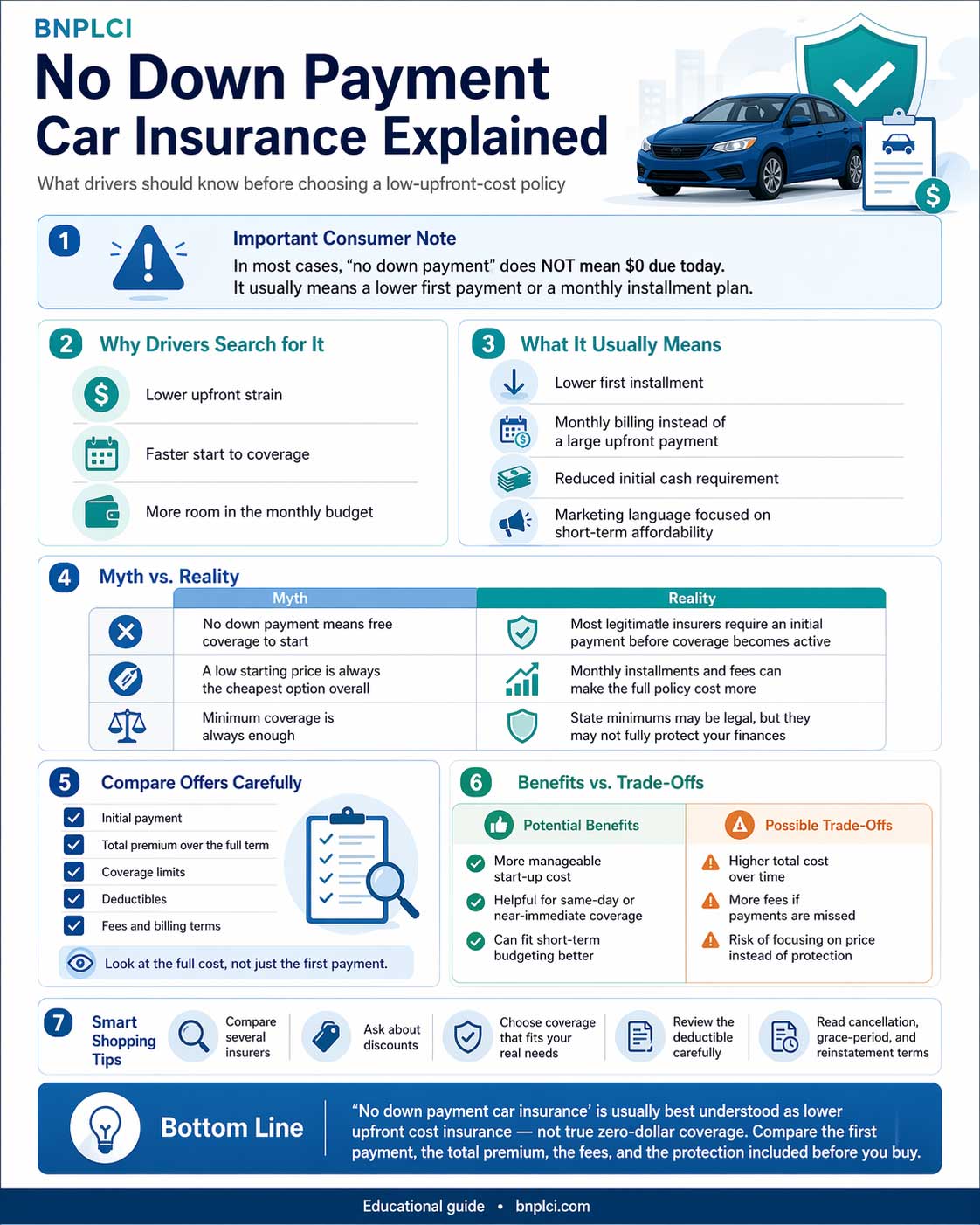
    Many drivers use the phrase no down payment car insurance when they are really looking for low upfront car insurance or a policy that starts with a smaller first payment. In practice, legitimate insurers typically require an initial payment before coverage begins. That first payment is usually part of your total premium, not a separate fee added on top.

    That distinction matters because it helps you compare quotes more accurately, avoid misleading offers, and choose a payment plan that fits your budget without sacrificing the coverage you may actually need.

    Buying a car already comes with major expenses: registration, fuel, maintenance, taxes, and monthly loan obligations for many drivers. Insurance adds another cost that cannot be ignored. In most states, drivers must carry insurance or otherwise prove financial responsibility to drive legally, and lenders often require additional protection such as collision and comprehensive coverage when a vehicle is financed or leased.

    That is why so many shoppers look for affordable ways to start coverage. If you are researching this topic, the real goal is usually not a literal zero-dollar start. It is finding a policy with a manageable first payment, clear terms, and coverage that protects you from a financial setback after an accident.

    For more background on flexible payment options, check this resource.

    1. It can reduce upfront pressure

    A lower initial payment can make it easier to get insured without draining your emergency cash. That can be especially helpful when you are also paying for registration, fuel, or repairs.

    2. It helps drivers get covered faster

    When coverage is legally required, a smaller first installment may help you activate your policy sooner and avoid a lapse that could lead to penalties or higher future rates.

    3. It improves cash-flow flexibility

    Some drivers prefer monthly payments because they fit better into regular budgeting, even if paying in full may cost less over the long term.

    What makes this option appealing?

    The biggest reason is straightforward: it can make the start of a policy feel more manageable. For students, first-time drivers, families dealing with several bills at once, and people rebuilding their finances, a smaller first payment can remove a practical barrier to getting legal coverage.

    It can also support better planning. Instead of putting a large amount down all at once, some drivers prefer to spread the cost over the policy term and keep more cash available for essentials. That does not automatically make monthly billing cheaper, but it can make coverage more accessible in the short term.

    How it may help your budget

    • Preserves more cash for urgent expenses such as repairs, fuel, or household bills.
    • Lets you compare payment plans instead of focusing only on one big upfront number.
    • May help you start a required policy sooner and avoid gaps in coverage.
    • Creates room to review deductible and coverage choices more carefully.
    • Encourages smarter shopping because the best option is not always the lowest advertised first payment.

    Five real reasons drivers look for low upfront car insurance

    1. They need legal coverage quickly

    Most drivers cannot wait weeks to insure a vehicle. A lower initial payment may help them activate coverage faster.

    2. They are managing several new-car costs

    Insurance is only one part of the total cost of owning a vehicle, so a smaller first payment may ease the transition.

    3. They want to avoid a coverage lapse

    A lapse can create legal and financial problems and may make future coverage more expensive.

    4. They are comparison shopping

    Drivers often want to see whether a cheaper first payment also comes with reasonable monthly costs and solid coverage.

    5. They need flexibility, not gimmicks

    The best policy is usually the one with clear billing terms, affordable premiums, and protection that matches the vehicle and driver.

    Myth vs. reality

    Common belief What is usually true Why it matters
    “No down payment” means you start with no money at all. Most legitimate insurers require an initial payment before the policy becomes active. You should review the first payment, the monthly payment, and the total premium together.
    The lowest upfront payment is always the best deal. A smaller first payment may come with higher monthly bills or weaker coverage. Always compare the full cost of the policy, not just the starting amount.
    Minimum coverage is always enough. Minimum limits may satisfy state rules but may not fully protect your finances after a serious accident. Low price should not come at the cost of being badly underinsured.
    Financed cars only need basic liability coverage. Lenders commonly require collision and comprehensive on financed or leased vehicles. Skipping required coverages can violate your loan or lease terms.

    What to compare before you buy

    What to review Why it matters Smart question to ask
    Initial payment This is what starts the policy and affects immediate affordability. Is this my first installment or an additional fee?
    Total premium A low first payment does not always mean the policy is cheap overall. What will I pay over the full six- or twelve-month term?
    Coverage limits State minimums may leave you exposed after a costly accident. Would these limits realistically protect me?
    Deductibles Changing deductibles can affect both price and out-of-pocket risk. Could I afford this deductible after a claim?
    Discounts Bundling, safe-driver, autopay, paperless, and multi-car discounts may lower the total cost. Which discounts am I already eligible for?

    Comparing benefits carefully can make a major difference, especially when you are deciding between flexible billing and traditional plans. This guide on BNPL vs Traditional Car Insurance can help you understand the trade-offs more clearly.

    How to lower your first payment without making a risky choice

    • Compare quotes from multiple insurers instead of choosing the first advertised offer.
    • Ask about discounts for autopay, bundling, good driving history, or paperless billing.
    • Choose only the coverages you truly need, while still meeting state and lender requirements.
    • Consider monthly payments if the main concern is getting started with a smaller amount upfront.
    • Review deductibles carefully so you do not lower the premium at the cost of an unaffordable claim later.

    For more guidance on improving your eligibility and preparing before you apply, review these tips on qualifying for buy now pay later options.

    FAQ

    Is no down payment car insurance really available?
    In most legitimate cases, no. What people usually find is a policy with a lower initial payment, often the first installment of the premium rather than a true zero-dollar start.
    Who usually looks for this type of policy?
    First-time drivers, budget-conscious households, students, and drivers trying to avoid a lapse in coverage often search for lower upfront insurance options.
    Can paying monthly be a smart option?
    It can be helpful for short-term affordability, but it is still important to compare the full policy cost because some insurers charge more overall when you do not pay in full.
    Does a financed car change what I need?
    Usually yes. If you finance or lease a car, your lender often requires collision and comprehensive in addition to any state-required liability coverage.
    What is the biggest mistake shoppers make?
    Focusing only on the first payment. A policy should be judged by total premium, coverage quality, deductibles, billing terms, and whether it actually protects you well enough.

    Conclusion

    The phrase no down payment car insurance is popular because drivers want relief from high upfront costs. But the smarter way to approach the search is to look for low upfront, clearly priced coverage from a legitimate insurer. A good policy should help you get insured promptly, fit your cash flow, and still provide protection that makes sense for your state requirements, your vehicle, and your financial situation.

    Ready to explore your options? Visit BNPLCI for more educational content and practical guidance on flexible payment approaches to car insurance.

    Editorial note: This article is for general educational purposes and should not replace advice from a licensed insurance professional. Coverage rules, payment options, underwriting, and required limits vary by state and insurer.

  • No Down Payment Car Insurance Explained

    Editorially reviewed informational content for U.S. car insurance payment options, no down payment topics, and flexible billing questions

    Editorial details
    • No Down Payment
    • Car Insurance Payments
    • Coverage Basics

    The BNPLCI.com Editorial Team creates informational content focused on car insurance payment options, no down payment topics, buy now pay later insurance questions, policy billing, and practical insurance shopping guidance for U.S. drivers.

    Articles are written to help readers better understand how first payments, installment schedules, total premiums, fees, deductibles, state requirements, lender expectations, and coverage choices may affect the real cost of starting or maintaining an auto insurance policy.

    This content is for general informational purposes only and does not constitute insurance, legal, credit, or financial advice. Coverage availability, pricing, payment terms, fees, discounts, and policy rules vary by insurer, provider, state, and driver profile. BNPLCI.com is an independent informational website and is not affiliated with any insurer.

    No down payment car insurance explained

    Many drivers use the phrase no down payment car insurance when they are really looking for low upfront car insurance or a policy that starts with a smaller first payment. In practice, legitimate insurers usually require some payment before coverage becomes active. That first payment is generally part of your premium, not a separate bonus charge added on top.[3][4]

    This distinction matters because it helps you compare quotes more accurately, avoid misleading offers, and choose a payment structure that fits your budget without overlooking the actual coverage you may need.

    Car insurance is one of the most important costs that comes with owning a vehicle. If you are shopping for a new policy, you may have seen offers that sound like you can start driving with no money upfront. In reality, what most shoppers want is a way to begin coverage with a smaller initial payment while keeping the monthly cost manageable.

    In simple terms, no down payment car insurance is often a marketing phrase used to describe a policy with a low first installment rather than a true zero-dollar start. The best way to evaluate these offers is to look past the headline and compare the full premium, the billing schedule, the fees, the deductible, and the actual protections included in the policy. If you are looking for a broader introduction to flexible upfront costs, this guide on affordable coverage without a down payment can help.

    Infographic explaining no down payment car insurance, including what it usually means, common myths vs reality, costs, benefits, trade-offs, and tips for comparing offers.

    Why People Search for This Type of Policy

    Lower Upfront Strain

    A smaller first payment can make it easier to get insured without draining cash needed for fuel, registration, repairs, or other immediate expenses.

    Faster Start to Coverage

    Drivers often need coverage quickly to register a vehicle, comply with state rules, or avoid a lapse that could make later insurance more expensive.

    More Room in the Budget

    Some drivers prefer spreading costs out over time instead of paying a large amount immediately, even if the total yearly cost may not be lower.

    What This Type of Offer Usually Means

    Most of the time, the phrase does not mean that the insurer gives you active coverage for free at the start. It more often means one of the following: the first billed amount is lower than expected, the premium is split into monthly installments, the company has an installment plan that reduces the initial cash requirement, or the advertisement is using broad wording to attract drivers who are shopping by short-term affordability.

    What to watch for: a small first payment can still lead to a higher total cost over the full policy term if installment fees, late fees, reinstatement fees, processing fees, low coverage limits, or high deductibles are part of the offer.

    • A small first payment can still lead to a higher total cost over the full policy term.
    • Installment fees, late fees, reinstatement fees, or payment processing fees may affect affordability.
    • Minimum coverage may satisfy state rules but may not fully protect your finances after a serious accident.[1]
    • If your car is financed or leased, the lender may require collision and comprehensive in addition to state-required liability insurance.
    • A very cheap starting price should always be reviewed next to the deductible, exclusions, and coverage limits.

    If you want a related explanation of how this connects to flexible payment models, you can also read what buy now pay later car insurance is.

    Myth vs. Reality

    Common Myth What Is Usually True Why It Matters
    “No down payment” means truly no money is due before coverage starts. Most legitimate insurers require an initial payment before activating the policy. You should compare the first payment and the total premium together.
    A low starting price always means the policy is cheaper overall. The monthly installments and added fees may make the full policy more expensive. The best comparison is the total cost for the six- or twelve-month term.
    Minimum coverage is always enough. State minimums are legal baselines, not always strong financial protection. Being underinsured can leave you paying large out-of-pocket costs after a claim.
    Financed cars only need liability. Many lenders require collision and comprehensive coverage. Ignoring lender requirements can create loan or lease problems.

    How to Compare No Down Payment Car Insurance Offers

    Item to Compare Why It Matters Question to Ask
    Initial payment This affects how quickly you can start the policy and what you need to pay today. Is this the first installment or a special fee structure?
    Total premium A lower opening payment does not automatically mean the policy is cheap overall. What will I pay over the full term?
    Coverage limits Low limits may meet minimum rules but still leave major gaps. Would these limits realistically protect me after a serious crash?
    Deductibles A higher deductible can lower the premium but increase your out-of-pocket risk. Could I afford this deductible if I had to file a claim?
    Fees and billing terms Installment charges and late fees can change the real cost of the policy. Are there monthly service fees, reinstatement fees, or cancellation fees?

    Benefits and Trade-Offs

    Potential Benefits

    • More manageable start-up cost
    • Helpful when you need same-day or near-immediate coverage
    • Can fit better into short-term budgeting

    Possible Trade-Offs

    • Higher total cost over time
    • More fees if you miss payments
    • Risk of focusing on price instead of protection

    How to Improve Your Chances of Finding a Better Offer

    • Compare quotes from several insurers instead of choosing the first ad you see.
    • Ask about discounts for bundling, autopay, paperless billing, good driving, or multi-car policies.
    • Choose only the coverages you actually need, while still meeting state and lender requirements.
    • Review the deductible carefully so a lower premium does not create a painful claim later.
    • Read policy terms before paying, especially around cancellations, grace periods, and reinstatement.

    For more practical guidance before applying, review these tips on qualifying for flexible payment options.

    FAQ

    Is no down payment car insurance really available?

    Usually not in the literal sense. In most cases, drivers are finding policies with lower upfront costs or monthly billing rather than a true zero-dollar start.

    What coverage do these policies usually include?

    That depends on the insurer and your state, but many policies start with liability coverage. Some drivers also add collision, comprehensive, uninsured motorist coverage, medical payments, or personal injury protection where applicable.

    Can a lower initial payment save money overall?

    Not always. A smaller first payment may help with immediate affordability, but the total premium and any installment fees may still make the policy more expensive over time.

    Why should financed drivers be extra careful?

    If your car is financed or leased, your lender may require physical damage coverage such as collision and comprehensive, so the cheapest quote may not meet all your obligations.

    What is the biggest mistake shoppers make?

    Looking only at the opening payment. A better comparison looks at the full premium, coverage limits, deductible, fees, exclusions, and the insurer’s billing terms.

    Conclusion

    No down payment car insurance is best understood as a search for lower upfront costs, not as free same-day coverage with no payment due. The right policy is the one that helps you start legally, fits your budget, and still gives you protection that makes sense for your state, your vehicle, and your financial situation.

    If you are comparing flexible payment options, use the headline offer as a starting point, then look deeper at the total cost, the billing structure, and the actual coverage. For more educational guides and comparison-focused content, visit BNPLCI.